
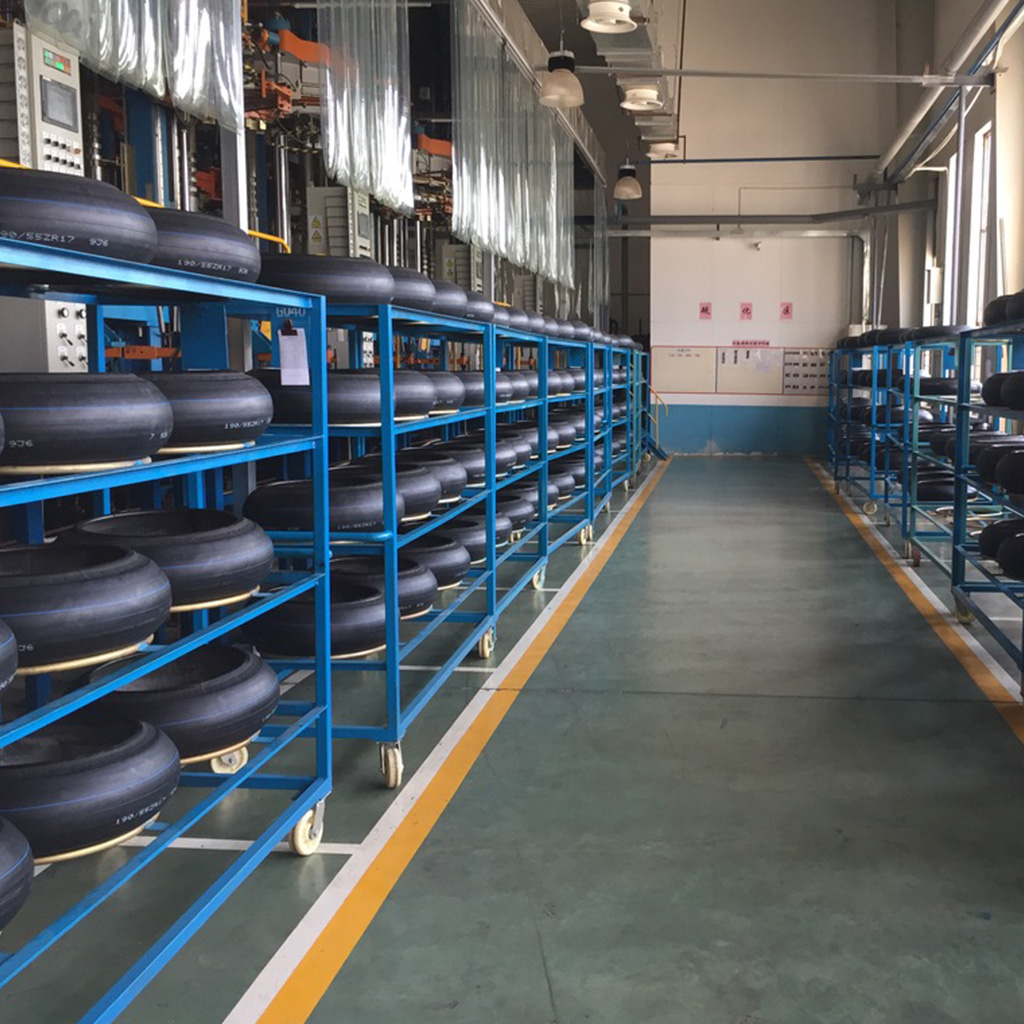
Tire quality control is the discipline that transforms raw materials into a reliable, high-performance motorcycle tire. A tire may look simple from the outside — a round black ring with tread pattern — but it is a precision-engineered composite structure containing rubber compounds, textile plies, steel or aramid belts, bead wires, and inner liner materials. Each component must be positioned within tight tolerances, cured under precisely controlled conditions, and inspected against defined acceptance criteria.
This article documents the quality control process at Motobike Más, from the moment raw materials arrive at our factory through to the final X-ray inspection before shipment. Our quality control system operates through 7 defined inspection points distributed across the production flow. Every tire passes through all 7 checkpoints. If a tire fails at any point, it is flagged, logged, and either reworked or rejected.
| Checkpoint | Stage | Inspection Type |
|---|---|---|
| 1 | Raw Material Receiving | Certificate of analysis verification + lab testing |
| 2 | Compound Mixing | Rheometer testing + physical property verification |
| 3 | Component Preparation | Dimensional measurement + visual inspection |
| 4 | Tire Building | Assembly verification + green tire inspection |
| 5 | Curing | Cure parameter monitoring + post-cure visual |
| 6 | Finished Tire Testing | Dynamic balancing + dimensional + X-ray |
| 7 | Final Inspection & Packaging | Visual + sidewall marking + documentation |
Every tire begins with raw materials. The quality of the finished tire cannot exceed the quality of its constituent materials. All incoming materials are sampled according to AQL sampling standards. Test results are compared to the material specification. Lots that fail are quarantined and returned to the supplier. Lots that pass are assigned a material batch number and released to the warehouse.
| Material Category | Examples | Tests Performed |
|---|---|---|
| Natural Rubber | RSS3, SVR3L, SIR20 | Mooney viscosity, ash content, PRI |
| Synthetic Rubber | SBR, BR, IIR, NBR | Mooney viscosity, bound styrene |
| Carbon Black | N220, N330, N550, N660 | Iodine adsorption, DBP absorption |
| Textile Reinforcement | Nylon cord, polyester cord | Breaking strength, H-adhesion |
| Bead Wire | Brass-plated steel wire | Tensile strength, coating thickness |
Each lot that fails testing is quarantined and returned. This ensures that only certified raw materials enter the production process.
Compound mixing is where individual raw materials are combined into the rubber formulations that become the tire’s components. Each compound batch follows a defined mixing cycle in our internal mixers, consisting of master batch, remill, and final batch stages. After mixing, each batch sample is tested for rheometer cure curve, Mooney viscosity, specific gravity, Shore A hardness, and scorch time. Batches that pass are released to the component preparation area. Batches that fail are quarantined for review.
Every compound batch carries a unique number that encodes production date, mixer line, shift, compound code, and sequence number. This number is recorded on every tire that uses compound from this batch.
At this stage, the approved compound batches are converted into tire components. Tread strips are checked for width and thickness via laser profile measurement. Sidewall strips are measured with calipers. Inner liner thickness is verified by online thickness gauge. Ply fabric cord density is checked via laboratory microscopy. Bead wire ring diameter is verified with go/no-go gauges. Any component found outside its tolerance band is flagged and either trimmed, reworked, or discarded.
Tire building assembles the individual components into a green (uncured) tire. We inspect splice alignment (straight with no gap or overlap beyond 2 mm), ply turn-up height (consistent left-to-right), bead placement (seated to correct height), and component centering (within ±2 mm). Green tire inspection is performed visually by the building machine operator and verified by a QC roving inspector.
Curing transforms the green tire into a unified, vulcanized structure. Each cure cycle is monitored for cavity temperature (±3°C of setpoint), platen pressure (±5% of setpoint), cure time (±10 seconds), and cooling curve. Parameters are logged automatically to our production database. Any deviation is flagged and quarantined. After curing, every tire is visually inspected for surface porosity, mold flash, tread and sidewall defects, bead area completeness, and color consistency.
This is the most comprehensive inspection stage. Every tire passes through dynamic balancing (measuring static and dynamic imbalance, classified as Grade A, B, or C), dimensional verification (diameter, section width, tread width, runout), and X-ray inspection for radial tires.
The X-ray system scans each radial tire’s internal structure to verify belt and ply cord alignment, splice integrity, bead structure, foreign object detection, and component positioning. X-ray images are reviewed by trained QC technicians and archived by tire serial number. This non-destructive testing method provides assurance that the internal construction of every radial tire meets design specifications for the product lifecycle plus one year.
This final stage of tire quality control verifies sidewall markings (size, load index, speed symbol, DOT code, ECE mark), documentation accuracy, and packaging according to customer specifications. Each shipment’s quality documentation is verified against production batch records before release.
When a tire fails any inspection checkpoint, it enters our non-conformance management system: identification with red tag, segregation in quarantine area, QC engineering review with disposition determination, root cause analysis using the 5-Why method, corrective action implementation, verification follow-up, and full documentation. This closed-loop system ensures that every quality issue is addressed at its source.
Beyond individual tire quality control inspections, we use SPC to monitor cure time and temperature trends, balance weight distribution, dimensional variation over time, and defect rates by production line and shift. SPC charts are reviewed weekly. Out-of-trend signals are investigated before they become out-of-spec conditions.
| Metric | Definition | Target |
|---|---|---|
| First Pass Yield | Tires passing all checkpoints without rework | >96% |
| Customer Reject Rate | Returns due to quality per 1,000 units | <0.5% |
| Dimensional Capability (Cpk) | Process capability for key dimensions | >1.33 |
| On-Time Delivery | Orders shipped on or before agreed date | >95% |
Our tire quality control process at 모터바이크 더보기 spans 7 checkpoints from raw material receipt through final X-ray inspection. This systematic approach to tire quality control is designed to catch defects at the source, prevent non-conforming material from reaching the next process step, and provide complete traceability. For B2B buyers, the takeaway is that quality at our factory is not a final inspection step — it is a system that runs through every stage of production.