
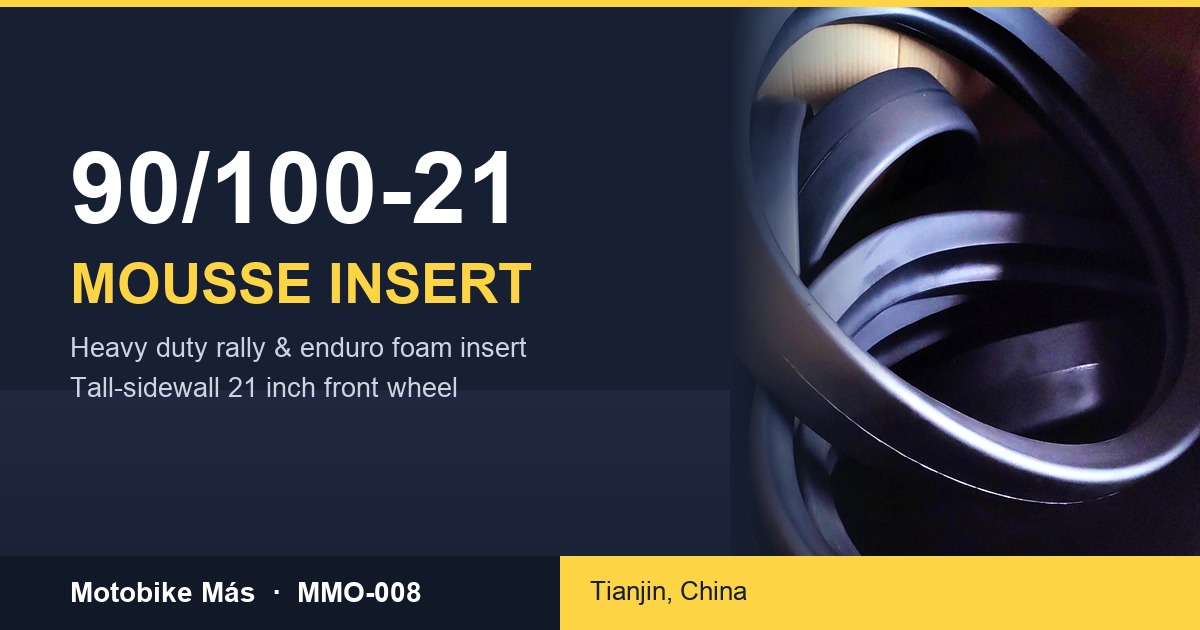
Le 90/100-21 is the only front mousse in the range that is specified around a rally rather than around a race, and the difference shows up in every published figure for it. A 90 mm section width on a 100% aspect ratio gives a 90 mm sidewall — the tallest of the three full-size 21 inch fronts — the published density tiers are named by duty rather than by softness (Medium, Standard, Heavy-Duty), and the published service life is 300–800 racing miles against 200–500 for every other size in the range.
Motobike Más builds the 90/100-21 Heavy Duty Motorcycle Mousse (SKU MMO-008) in its own Tianjin factory. It replaces the inner tube inside a 90/100-21 front off-road motorcycle tire, carries the load that compressed air would otherwise carry, and removes up to 40% of the rotating mass that a tube plus a heavy-duty rim lock would put on the front of the bike. The tire around it is still inflated with air at normal tire pressure — the mousse provides the structure, the air sets the profile and grip.
This guide covers the specifications, the three density tiers and how they differ from the naming used on every other size, the machines the size fits, the rally service and preparation regime, and how distributors order it.
Dernière mise à jour : 20 November 2026. Sources des données : the published Motobike Más specifications for MMO-008, the factory’s published fitment, density, pressure and lifespan tables, and the factory’s size and certification documentation. Figures shown as “≈” are calculated from the published tyre size designations rather than measured by the factory.
A 90/100-21 is a 90 mm section width on a 100% aspect ratio, giving a 90 mm sidewall and an overall diameter of roughly 713 mm on a 21 inch rim. That makes it the tallest of the three full-size front sizes the factory publishes, and the largest overall diameter in the whole range — about 18 mm more than the 90/90-21 and 20 mm more than the 80/100-21, both of which share the same 21 inch rim.
The extra height is the point. On a rally stage the front wheel is asked to absorb a square edge at 140 km/h, then a whoop section, then a gravel wash, and it is asked to do all of that for hours rather than for the length of a motocross race. A taller sidewall gives the carcass more travel before the load reaches the rim, and that is why the published comparison calls this the tallest of the three fronts with the most cushioning, and the 90/90-21 the balanced one and the 80/100-21 the quickest to turn in.
What the insert does not do is change the size of the tire. A 90/100-21 insert is cut for a 90 mm section width on a 100% aspect ratio on a 21 inch rim, and it will not seat correctly in a 90/90-21 or an 80/100-21 tire even though all three run on the same rim diameter. The full size-by-size compatibility picture is on the Guide des tailles des inserts en mousse, and the fitting method is in the Guide d'installation de l'insert en mousse.
Read off the sidewall, 90/100-21 means a 90 mm section width, a 100% aspect ratio and a 21 inch rim diameter. The section width is how much rubber the tire puts on the ground; the aspect ratio is how tall the sidewall is as a percentage of that width. At 100% the two numbers are the same, giving a 90 mm sidewall and an overall diameter of roughly 713 mm.
That diameter is worth checking against the rear of the same machine, because on a rally bike the rear is usually an 18 inch size. The 120/90-18 rally rear works out at roughly 673 mm, so a rally bike on this front runs a front about 40 mm taller in overall diameter than its rear — a much larger gap than a full-size motocross bike carries, and the reason a rally bike sits so noticeably nose-high. The gearing is set around that difference, and it is one of the reasons the front tire on a rally machine is not interchangeable with the front tire from a different class of bike even when the rim diameter matches.
| Item | Statut |
|---|---|
| Poids unitaire | Published — approximately 1.1–1.3 kg |
| Pression effective équivalente | Published — 8–12 psi depending on tier |
| Typical service life | Published — 300–800 racing miles, rally endurance-rated |
| Density tiers and terrain guidance | Published — Medium, Standard, Heavy-Duty |
| Compatible machines | Published on the product page |
| Shelf life | Published — 3–5 years sealed, stored below 25°C in the dark |
| Bar-equivalent rating for each tier | Not published — confirmed with the factory per order |
| Measured rim width and permitted rim width range | Not published — request the current figure from the factory |
| Load index and load rating | Not published — request the current figure from the factory |
| Heat resistance rating in degrees | Not published — request the compound specification from the factory |
| Minimum order quantity and current lead time | On request — confirmed with the factory per order |
| Taille | Largeur de la section | Format d'image | Hauteur du flanc | Diamètre de la jante | Diamètre total |
|---|---|---|---|---|---|
| 90/100-21 — this size | 90 mm | 100% | ≈ 90 mm | 21 in | ≈ 713 mm |
| 90/90-21 — enduro front | 90 mm | 90% | ≈ 81 mm | 21 in | ≈ 695 mm |
| 80/100-21 — MX front | 80 mm | 100% | ≈ 80 mm | 21 in | ≈ 693 mm |
| 120/90-18 — pneu arrière de rallye | 120 mm | 90% | ≈ 108 mm | 18 pouces | ≈ 673 mm |
| 140/80-18 — heavy-duty rear | 140 mm | 80% | ≈ 112 mm | 18 pouces | ≈ 681 mm |
| 110/90-19 — standard MX rear | 110 mm | 90% | ≈ 99 mm | 19 pouces | ≈ 681 mm |
Les valeurs “ ≈ ” sont calculées à partir des désignations de dimensions publiées : la hauteur du flanc correspond à la largeur de la section multipliée par le rapport d'aspect, et le diamètre total correspond au diamètre de la jante plus deux fois la hauteur du flanc. Elles sont utiles pour comparer les dimensions entre elles et ne constituent pas des mesures effectuées en usine ; l'usine confirme les dimensions mesurées sur demande. Le tableau complet des diamètres pour chaque dimension publiée se trouve sur la page Guide des tailles des inserts en mousse.
Motobike Más publishes four front mousse sizes, and they cover four different jobs rather than four versions of the same part. The 70/100-19 is the youth and pit-bike front, the 80/100-21 is the motocross and supercross front, the 90/90-21 is the standard enduro and trail front, and the 90/100-21 is the rally, extreme enduro and adventure front. Only one of them is the tallest, only one is the heaviest, and only one has a longer published life.
| Spécifications | 70/100-19 | 80/100-21 | 90/90-21 | 90/100-21 |
|---|---|---|---|---|
| Largeur de la section | 70 mm | 80 mm | 90 mm | 90 mm |
| Format d'image | 100% | 100% | 90% | 100% |
| Diamètre de la jante | 19 pouces | 21 inch | 21 inch | 21 inch |
| Application typique | Youth motocross and pit bike | Motocross and supercross | Enduro, trail and off-road | Rally, extreme enduro and adventure |
| Poids unitaire de la mousse | Approximately 0.9–1.1 kg | Approximately 0.9–1.1 kg | Approximately 1.0–1.2 kg | Approximately 1.1–1.3 kg |
| Published density tiers | Doux, moyen, standard | Doux, moyen, standard | Doux, moyen, standard | Moyen, Standard, Lourd |
| Published rider weight for the softest tier | Under 50 kg | Moins de 70 kg | Moins de 70 kg | Moins de 75 kg |
| Durée de vie indiquée | 200 à 500 miles de course | 200 à 500 miles de course | 200 à 500 miles de course | 300–800 racing miles |
Three lines in that table are worth reading carefully, because each one is a different kind of decision.
The first is the sidewall. The 90/100-21 gives a 90 mm sidewall, against 81 mm on the 90/90-21 and 80 mm on the 80/100-21 — roughly 10 mm more travel before the load reaches the rim, and 20 mm more overall diameter. That is the cushioning that makes a high-speed gravel stage survivable, and it is also what makes a bike on this front sit higher and feel slower to turn than a bike on the 80/100-21.
The second is the density tiers, and this is where the naming difference becomes commercially important. The other three front sizes are all published as Soft / Medium / Standard; this one is published as Medium / Standard / Heavy-Duty. A distributor carrying all four front sizes therefore has two different tier systems on the shelf, and a customer asking for “the medium one” needs to be asked which system they mean.
The third is the published service life: 300–800 racing miles here, against 200–500 for the other three. That is not a marketing difference, it is the difference between a front tire that is managed between events and one that is replaced when it shows its signs, and it is the practical reason a rally or expedition programme is a different order from a motocross one.
For the wider fitment picture, the Guide des tailles des inserts en mousse lists every published size with its tier system, weight and life, and the mousse selection guide for enduro riding covers how to match a front size to the terrain a customer actually rides.
This size is published with its own three-tier structure — Medium, Standard and Heavy-Duty — and the naming is deliberate rather than a variation on the Soft / Medium / Standard used by the other sizes in the range. That difference is worth understanding before a purchase order goes out, because a buyer who treats the two naming schemes as interchangeable will order the wrong thing.
| Density tier | Effective pressure | Best terrain | Rider weight |
|---|---|---|---|
| Moyen | 8 à 10 psi | Enduro technique, rallye boueux, terrain mixte | Moins de 75 kg |
| Standard | 9 à 11 psi | Rallye polyvalent, cross-country, désert | 75–95 kg |
| Usage intensif | 10 à 12 psi | Désert à grande vitesse, terrain rocailleux, durabilité accrue | Plus de 90 kg |
On the other seven published sizes the tiers describe how hard the foam is, and they run from the softest to the firmest. On this size the tiers describe how much duty the foam is being asked to do, and they run from Medium upward. There is no soft end, and that is the point: this is a front wheel for machines that travel at rally speed, so the published question is not “how much grip do I need in the forest” but “how much heat and how many hours of sustained running will this tire have to absorb”.
The published terrain guidance follows that reading rather than the usual one. The Medium tier is published for technical enduro, muddy rally and mixed terrain — the conditions where the tire has to work rather than survive. The Standard tier is the general rally, cross-country and desert choice, and the Heavy-Duty tier is published specifically for high-speed desert, rocky terrain and extended durability, with the rider-weight band at over 90 kg.
The published rider-weight bands are also different from the rest of the range: under 75 kg on the Medium tier, 75–95 kg on Standard, over 90 kg on Heavy-Duty. The band a rider sits in therefore selects the duty the insert is rated for, not simply how soft the foam feels. How the rating is labelled is one of the things the factory confirms per order, and the naming convention used across every SKU is set out on the Guide des tailles des inserts en mousse.
A rally front wheel does a job that no other front wheel in the range does, and it is worth describing the job rather than leaving it to a specification table.
At rally speed the front wheel is doing braking work at a rate a motocross front never sees. On a mixed-surface stage the rider is on the front brake for long stretches at high speed, and the tire is carrying that load through a carcass that is also absorbing impacts. The published comparison for this size makes the point that the tall sidewall works with foam damping rather than an air spring that can bottom out — and an air spring that reaches the end of its travel at speed is a very different event from foam reaching the end of its compression.
Rotating mass at the front is a fatigue problem, not just a handling one. The published figure for this size notes that up to 40% less rotating mass at the front reduces gyroscopic effect at rally speeds above 140 km/h and cuts rider fatigue over marathon stages. That is a different consequence from the one usually quoted for rotating mass. On a motocross bike, less mass at the front means faster direction changes; on a rally bike at 140 km/h, less mass at the front means less of the rider’s body weight is being fought by a wheel that wants to keep going straight, and a stage that is measured in hours rather than minutes is where that compounds.
Heat is the failure mode, and it is not recoverable. The published service-life table for this size states plainly that heat build-up during prolonged high-speed running is the primary cause of mousse failure in rally use, and that a mousse should be warm, not hot. That is the single most useful line on the product for a rally buyer, because it means the insert is not failing from punctures and it is not failing from distance — it is failing from the thing a rally front does that nothing else does, which is run hot for a long time.
Which is why this size carries the range’s longest published life. At 300–800 racing miles against 200–500 for every other size, and at a published unit weight of approximately 1.1–1.3 kg against 1.0–1.2 kg for the 90/90-21 and 0.9–1.1 kg for the 80/100-21, the front tire for a rally bike is both the heaviest and the longest-lived of the three full-size fronts. The hard enduro versus desert racing comparison covers the terrain side of the choice, and the published lifespan guide covers the hours-based figures across the range.
| Classe | Modèles |
|---|---|
| Rally motorcycles | KTM 450 Rally Factory Replica, Honda CRF450 Rally, Husqvarna FR 450 Rally, GasGas RC 450F Rally, Hero 450 Rally, Sherco 450 SEF Rally, custom rally builds on enduro platforms |
| Enduro / cross-country | KTM 300 XC-W, KTM 350 EXC-F, KTM 500 EXC-F, Husqvarna TE 300, FE 350, FE 501, Beta RR 300 / RR 350 / RR 430 / RR 480, Sherco SE 300 / SE 500 / SE 700, GasGas EC 250 / EC 300 |
| Adventure bikes with a 21 inch front | Honda CRF450RL, KTM 890 Adventure R on selected tire fitments, Husqvarna Norden 901 on selected tire fitments |
The published fitment splits into three groups, and each one uses the size for a different reason.
The rally group is the reason the size exists: the KTM 450 Rally Factory Replica, Honda CRF450 Rally, Husqvarna FR 450 Rally, GasGas RC 450F Rally, Hero 450 Rally and Sherco 450 SEF Rally, plus custom builds on enduro platforms. These are machines specified for competition at speed over distance, and the front tire is the one that has to absorb it.
The enduro and cross-country group is the one that surprises people — the KTM 300 XC-W, 350 EXC-F and 500 EXC-F, the Husqvarna TE 300 / FE 350 / FE 501, the Beta RR range, the Sherco SE machines and the GasGas EC 250 and EC 300. These are the same platforms that appear on the 90/90-21 front guide, and the difference is that a rider fitting a rally front is usually building toward a rally rather than toward a local enduro day, which is a decision made at the start rather than after a puncture.
The adventure group is the third: the Honda CRF450RL, plus the KTM 890 Adventure R and Husqvarna Norden 901 on selected tire fitments. This is the case where the published wording matters — selected fitments, not universally. A machine that specifies a 90/100-21 front does so deliberately for its taller profile and rally-rated construction, and the fitment has to be read from the machine rather than assumed from the model name.
The argument for mousse on the front is not theoretical. These are the practical differences a rally team feels over a multi-day event.
| Facteur | Mousse insert | Chambre à air |
|---|---|---|
| Prévention de l'aplatissement | Complet — pas de chambre à air à perdre | Vulnerable to pinch flats and punctures |
| Précision de la direction | Identical from the first stage to the last | Changes with pressure, temperature and altitude |
| Impact absorption | Tall sidewall plus foam damping | Tall sidewall plus an air spring that can bottom out |
| Masse en rotation | Partie inférieure — sans tube et avec un verrou de jante plus léger | Plus élevé |
| High-speed stability | Up to 40% less rotating mass at the front, which reduces gyroscopic effect at rally speeds above 140 km/h and cuts rider fatigue over marathon stages | Base de référence |
| Temperature behaviour | Identical damping from a cold morning start to an afternoon desert stage | Pressure drifts with ambient temperature |
| Maintenance between stages | None — no pressure checks, no valve inspection, no gauges in the tool kit | Pressure check at every refuelling stop |
| Réutilisation | Transfer to a new tire if still serviceable | Replaced at every tire change |
| Adaptabilité au terrain | Fixed by the density tier chosen | Adjustable through pressure |
Three rows in that table carry the argument on this size, and they are the three that a tube setup does badly.
The first is impact absorption. The published comparison puts the mousse at a tall sidewall plus foam damping, against a tall sidewall plus an air spring that can bottom out. At rally speed on a wash, an air spring that reaches the end of its travel does not absorb anything further — it transmits — and the rim takes what is left.
The second is maintenance between stages. A tube means a pressure check at every refuelling stop, a valve to inspect, and gauges in the tool kit. Over a multi-day event that is a routine repeated dozens of times, and it is work that produces nothing except the knowledge of whether the tire is still holding air. The mousse removes it entirely, and that matters more in a rally service park than it does at a race track.
The third is temperature behaviour. A tube’s pressure drifts with ambient temperature from a cold morning start to an afternoon desert stage, and on a bike that is being used across both, the tire the rider tuned at dawn is not the tire that is on the bike at midday. A mousse holds its damping identical across that range.
The general comparison across sizes, including the rear-wheel cases and the cost side of the argument, is in Insert en mousse ou chambre à air ?, et les différents systèmes à cellules fermées sont comparés dans La mousse face au système Tubliss.
The published service life for the 90/100-21 is 300–800 racing miles, rally endurance-rated, and that is longer than the 200–500 published for every other size in the range. The published reason is the Heavy-Duty tier and the compound formulation for sustained high-speed operation, and the practical consequence is that an insert on this size is managed rather than simply ridden out.
| Item | Détail |
|---|---|
| Published service life for this size | 300–800 racing miles, rally endurance-rated |
| Why it outlasts a standard size | The Heavy-Duty density option and the compound formulation for sustained high-speed operation |
| Replace when | It feels noticeably softer or spongy compared with new, there are visible tears, chunks missing or deformation, it deforms, or the steering feel goes vague and front-end confidence drops |
| Heat is the failure mode | A mousse should be warm, not hot. Heat build-up during prolonged high-speed running is the primary cause of mousse failure in rally use, and it is not recoverable |
| Proactive replacement | Replacement after a major rally event is recommended rather than left to ride to failure |
| Before the event | Heavy-Duty tier with a fresh tire fitted, plus a 50–100 km pre-run so the mousse settles into the casing |
Three of those rows are the operating discipline for this size, and they are specific to it.
Proactive replacement. The published guidance is that replacement after a major rally event is recommended rather than left to ride to failure. That is a different model from the rest of the range, where an insert is inspected and replaced when it shows its signs. On a rally front the accumulated heat of an event is itself the reason to change it, whether or not it still feels fine — and because a rally front is the expensive end of the bike to run down, that discipline is what keeps a single event from becoming two.
The pre-run. The published preparation routine calls for the Heavy-Duty tier with a fresh tire fitted, plus a 50–100 km pre-run so the mousse settles into the casing. That is a real piece of engineering: a closed-cell insert needs to take up the shape of the carcass it is running in before it is asked to absorb a rally stage at speed, and the pre-run is what makes the first hours of the event predictable.
Heat as the failure mode. The published table states that heat build-up during prolonged high-speed running is the primary cause of mousse failure in rally use and that it is not recoverable. A mousse should be warm, not hot. This is the check that matters on this size, and it is the one most often left until after an event rather than before it.
The replacement and storage criteria that apply across every size are covered in mousse insert lifespan et how long a motorcycle mousse lasts, and the full published lifespan table by use case is on the Guide des tailles des inserts en mousse.
N'utilisez jamais de lubrifiants à base de pétrole sur un insert en mousse. Les produits pétroliers altèrent le caoutchouc nitrile, et un insert endommagé constitue un risque, et non une économie. Utilisez exclusivement un lubrifiant en mousse à base d'eau, tant à l'intérieur de la carcasse du pneu que sur l'insert lui-même.
La séquence générale — préparation du logement du talon, application du lubrifiant, premier talon, deuxième talon, mise en place définitive et cycle de pression permettant de définir le profil — est décrite dans le Guide d'installation de l'insert en mousse et s'applique tel quel à cette taille.
Three points are specific to a rally front.
Clean the 21 inch front rim bead seat area thoroughly. A rally front is the wheel with the most material around the bead seat — a 90 mm section on a 100% aspect ratio is the tallest carcass in the range — and any grit left in the bead area shows up immediately as a bead that will not seat evenly and an insert that sits off-centre. On the front, off-centre is felt as a vague steering response at exactly the point in a stage where the rider is trusting it.
Work evenly around the casing. The published fitting guidance calls for the mousse to be worked evenly around the casing as it goes in, and this is the size where that matters most, because the carcass has the most length of rubber to fold down onto the rim.
Check the axle and spacers are aligned after the wheel goes back on. The published front-wheel fitting procedure ends with installing the front wheel and ensuring the axle and spacers are properly aligned. On a front wheel that has been asked to take a square edge at 140 km/h, an alignment problem shows up as a steering feel that changes after the first hard impact, and it is easy to attribute that to the tire.
The pre-event routine published for this size — Heavy-Duty tier, fresh tire, and a 50–100 km pre-run to settle the mousse into the casing — is set out in the service life section above.
Motobike Más fabrique de la mousse dans son usine de Tianjin, située dans le district de Nankai, qui s'étend sur 50 000 m² comprenant des zones de production, des entrepôts et des locaux dédiés à la R&D. L' Visite guidée complète de l'usine présente les chaînes de production, le système de stockage et les systèmes de qualité qui sous-tendent cette gamme.
The 90/100-21 is cut as a 21 inch, 90 mm front insert, and the compound published for it is a rally-specific endurance formulation rather than the standard front compound — the published custom formulations for this SKU include rally-specific endurance formulations as an option on the OEM route. It carries the same inspection regime as the rest of the range: density testing, compression recovery testing, heat resistance testing, dimensional inspection and structural integrity verification before packing.
The check that matters most on this size is heat resistance, because heat is the published failure mode for it. The published heat resistance rating in degrees for this SKU is confirmed with the factory on request rather than published as a fixed figure, so a rally buyer who needs it specified for a particular event should ask for it directly rather than assume it matches another size. The full inspection regime is described in the Présentation du processus de contrôle qualité.
The 90/100-21 is supplied as a made-to-order factory line rather than from finished-goods stock. The terms that apply across the range — the minimum set per order and confirmed on request, standard OEM production at 15–30 days depending on quantity and customization, pre-production samples for evaluation, and shipping by sea on FOB Tianjin terms, by air freight or DDP — are published together on the Guide des tailles des inserts en mousse, le Guide d'achat en gros et le Fabrication OEM et ODM pages.
This size is worth approaching commercially as the rally and endurance end of the range rather than as another front size. It is the SKU that lets a supplier be quoted for a rally programme and a marathon endurance event on the same product, and the rally-specific endurance formulation route on the OEM service is the response when a team needs a compound specified for a particular event rather than a general duty rating.
Because the front sizes run on one line with the same tooling, a distributor serving the rally, enduro and motocross ends of the same market can combine the 90/100-21 with the 90/90-21 et le 80/100-21 on a single purchase order, and the rear sizes on the same order as well.
A front tire size used primarily on rally racing motorcycles and on select extreme enduro applications. Its 100% aspect ratio gives a 90 mm sidewall, which is the tallest of the three full-size 21 inch fronts the factory publishes and about 9 mm more sidewall than the 90/90-21, giving more impact absorption at speed. The published overall diameter is roughly 713 mm against 695 mm and 693 mm, which is why a rally bike on this front sits noticeably nose-high and why the tire is not interchangeable with the front from another class of bike even though the rim diameter matches.
It runs on a standard 21 inch rim, yes, and it is the rim diameter that makes it easy to confuse with the other two full-size fronts. What changes is the profile: at 100% aspect ratio on a 90 mm section, the sidewall is 90 mm and the overall diameter is roughly 713 mm, against 81 mm and 695 mm on the 90/90-21 and 80 mm and 693 mm on the 80/100-21. Same rim, different tire, different insert, and a different gear ratio and axle height when a bike moves between them.
On this size the tiers are a duty rating rather than a softness scale, which is the key difference from every other size in the range. The three published tiers are Medium, Standard and Heavy-Duty, running upward in duty rather than across a soft-to-firm range. The published distinction is that Standard is for all-around rally, cross-country and desert work, while Heavy-Duty is published specifically for high-speed desert, rocky terrain and extended durability, at 10 to 12 psi and for riders over 90 kg. The published reason the size outlasts a standard one is the Heavy-Duty density option together with the compound formulation for sustained high-speed operation.
Medium, Standard or Heavy-Duty, and the published guidance maps onto what the stage actually is. Medium is published for technical enduro, muddy rally and mixed terrain at 8 to 10 psi, for riders under 75 kg. Standard is the general rally, cross-country and desert choice at 9 to 11 psi, for 75 to 95 kg. Heavy-Duty is published for high-speed desert, rocky terrain and extended durability at 10 to 12 psi, for riders over 90 kg. Because the tiers are duty ratings, the tier a rider selects is the duty the insert will be asked to do rather than simply how the foam feels.
The published effective pressure equivalent for this size is 8 to 12 psi depending on the tier selected, against the 12 to 18 psi typically used for a tube setup on the same off-road tire. The published tier table puts 8 to 10 psi on Medium, 9 to 11 psi on Standard and 10 to 12 psi on Heavy-Duty. The tier and the tire pressure are separate settings, and the tire pressure is set from the bike’s own guidance rather than from the pressure equivalent, which is a rating of the foam rather than an instruction.
Motobike Mas publishes 300 to 800 racing miles for the 90/100-21, rally endurance-rated, against 200 to 500 for every other size in the range. The published reason is the Heavy-Duty tier and the compound formulation for sustained high-speed operation. In practice this size is managed rather than ridden out: the published guidance recommends replacement after a major rally event rather than leaving it to fail, and calls for the Heavy-Duty tier with a fresh tire plus a 50 to 100 km pre-run so the mousse settles into the casing before the event.
No. Mousse inserts are size-specific and are cut for one tire size and one profile. Although both run on a 21 inch rim, the 90/100-21 has a 90 mm sidewall against 81 mm on the 90/90-21, which is a different carcass with a different internal volume, and the insert will not sit correctly in it. Forcing it results in improper fitment, reduced performance and a safety risk. Fit the insert that matches the designation printed on the tire.
Yes, and the type matters. Never use petroleum-based lubricants on a mousse insert, because petroleum products degrade nitrile rubber. Use water-based mousse lubricant only, on both the inside of the tire casing and the insert itself. Three points are specific to this size: clean the 21 inch front rim bead seat area thoroughly, work the mousse evenly around the casing as it goes in, and check the axle and spacers are properly aligned after the wheel goes back on, because the front wheel is the one absorbing the impacts and an alignment problem there is felt immediately in the steering.
The minimum for the 90/100-21 is set per order and confirmed by the factory on request, because this size is made to order rather than pulled from finished-goods stock. Standard OEM production typically runs 15 to 30 days depending on quantity and customization, pre-production samples are available for evaluation before a bulk order, and shipping is by sea on FOB Tianjin terms, by air freight or DDP. Because the three full-size front sizes share one production line, a distributor can combine the 90/100-21 with the 90/90-21 and the 80/100-21 on a single purchase order.
Motobike Mas manufactures tires and mousse inserts under ISO 9001:2015 quality management, to DOT and ECE production standards. Every insert also passes density testing, compression recovery testing, heat resistance testing, dimensional inspection and structural integrity verification before packing. On this size the heat resistance check carries particular weight, because heat build-up during prolonged high-speed running is the published primary cause of mousse failure in rally use, and the published heat resistance rating in degrees for this SKU is confirmed with the factory on request rather than published as a fixed figure.
The 90/100-21 Heavy Duty Motorcycle Mousse (SKU MMO-008) is produced on the Motobike Más line in Tianjin and supplied to importers, distributors, dealers, race teams and aftermarket brands worldwide. It is available in Medium, Standard and Heavy-Duty tiers, with a published unit weight of approximately 1.1–1.3 kg, an effective pressure equivalent of 8–12 psi, and a published service life of 300–800 racing miles — the rally endurance-rated figure that is unique to this size in the range.
Ask for the current minimum, the density tier mix and the lead time on the 90/100-21, or take a set of pre-production samples before placing a bulk order. Because the front sizes share one line, a distributor covering rally, enduro and motocross can combine the 90/100-21 with the 90/90-21 and the 80/100-21 on one purchase order — and private-label production with custom branding, packaging and colours is available on this SKU, along with rally-specific endurance formulations.
Le 90/100-21 product page contient les spécifications complètes et la page de contact de l'usine takes specification requests directly. Distributors should read the Guide des tailles des inserts en mousse for the full size and tier comparison including the naming conventions used across every SKU, and the Dossiers de certification ISO 9001, DOT et ECE for the file a distributor needs.
80/100-21 Mousse Insert | Motocross Front Fitment Guide dit :
[…] mousse covers the 85cc class and 19 inch pit-bike fronts. At the other end of the front range, the 90/100-21 heavy duty rally front mousse covers the taller-sidewall rally and extreme enduro […]
140/80-18 Mousse Insert | Heavy Duty Enduro & Adventure dit :
[…] version of it is the one worth stocking. For the matching rally front on those same bikes, the 90/100-21 heavy duty rally front mousse covers the taller-sidewall 21 inch […]
Insert en mousse 70/100-19 | Guide de compatibilité pour casques MX junior (avant) dit :
[…] a distributor has to decide which front widths the range actually covers. A fourth front size, the 90/100-21 heavy duty rally front mousse, covers the taller-sidewall rally and extreme enduro […]
90/90-21 Mousse Insert | Off-Road Enduro Front Fitment Guide dit :
[…] around, which makes it the easier size to stock alongside the 90/100-21 rally front covered in the 90/100-21 rally mousse guide. Riders choosing between the two front approaches for an adventure build are comparing a 90/90-21 […]
Mousse Insert Size Guide 2026 | 9 Sizes, Charts & Fitment dit :
[…] with the detail that applies to it: the 80/100-21 motocross front, the 90/90-21 enduro front, the 90/100-21 rally front, the 70/100-19 youth front, the 90/100-16 youth rear, the 110/90-19 standard rear, the 100/90-19 […]