
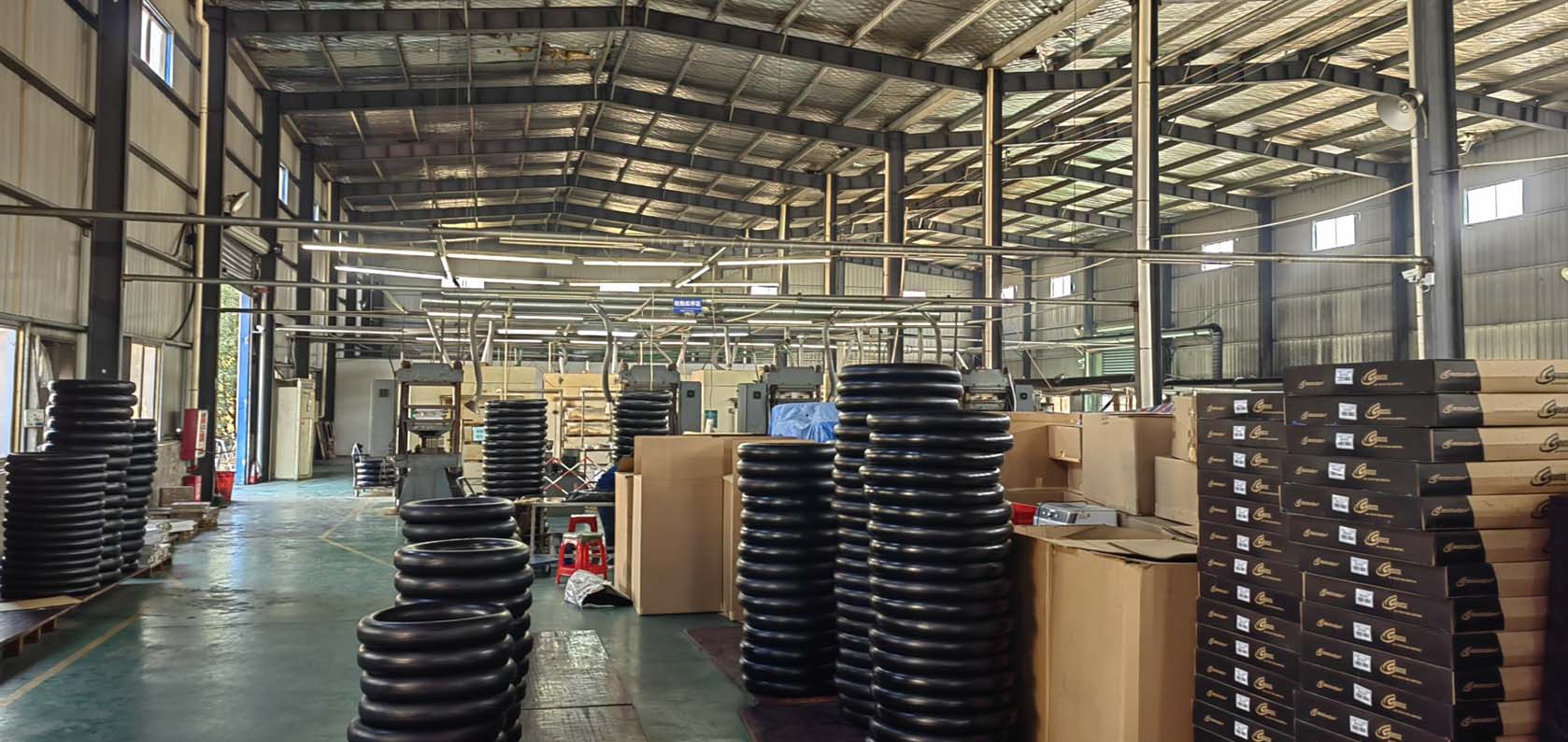
O 140/80-18 is the heaviest rear tire the factory publishes, and the reason is not that it is the widest — it is that it is the one built for a machine that carries a load. A 140 mm section width on an 80% aspect ratio gives a 112 mm sidewall, the tallest in the range, on an 18 inch rim, and the mousse inside it is a high-density elastic foam specified for the rear of an adventure motorcycle rather than for the rear of a motocross bike.
Motobike Más builds the 140/80-18 Heavy Duty Motorcycle Mousse (SKU MMO-002) in its own Tianjin factory. It is supplied in four density grades — 1.1bar, 0.8bar, 0.5bar and 0.3bar — and the published compound on this size is specified around three measured properties that the rest of the range does not carry: 28% higher compression resistance, 22% lower structural fatigue rate and 30% improved load support performance, with stable operation above 120°C. It replaces the inner tube, carries the load compressed air would otherwise carry, and the tire around it is still inflated with air at normal tire pressure — the mousse provides the structure, the air sets the profile and grip.
This guide covers the specifications, the load data that makes this size different, the four density grades and what each is for, the machines it fits, service life and how distributors order it.
Última atualização: 20 November 2026. Fontes de dados: the published Motobike Más specifications for MMO-002 and the factory’s published fitment, density and lifespan tables. Unit weight for this SKU is published as available on request, and the factory confirms the current figure per order. Figures shown as “≈” are calculated from the published tyre size designations rather than measured by the factory.
A 140/80-18 is a 140 mm section width on an 80% aspect ratio, giving a 112 mm sidewall and an overall diameter of roughly 681 mm on an 18 inch rim. That is 20 mm more rubber across the tire than the standard full-size rear, and 13 mm more sidewall height, on the same rim diameter as the rally rear.
Both of those numbers exist for one reason: load. A 140 mm footprint spreads the rear load over more rubber, and a 112 mm sidewall flexes further before the carcass runs out of travel, so the same impact reaches the rim with less force and the same sustained load is carried with less permanent deformation. On an adventure motorcycle carrying a rider, luggage and a fuel load over a rocky day, those are the two properties that decide whether the rear tire is still working at the end of it.
What the insert does not do is change the size of the tire. A 140/80-18 insert is cut for a 140 mm section width on an 80% aspect ratio on an 18 inch rim, and it will not seat correctly in a 120/90-18 or a 110/90-19 tire. The full size-by-size compatibility picture is on the Guia de tamanhos para inserções de mousse, e o método de ajuste encontra-se no Guia de instalação do inserto de espuma.
The published specification for the 140/80-18 includes a table of average rear tire load by motorcycle type, and it is the single most useful piece of data on the product page:
| Motorcycle type | Average rear tire load |
|---|---|
| Motocross bike | 90–120 kg |
| Enduro motorcycle | 120–160 kg |
| Adventure motorcycle | 180–260 kg |
The spread in that table is the whole argument for this size. The gap between a motocross bike and an adventure motorcycle is not marginal — the published average rear tire load is more than double, and the middle case sits in between. A standard rear insert specified for the motocross figure is being asked to do more than twice the work on the adventure bike, and the failure it produces is not a puncture but an insert that has taken a permanent set under a load it was never rated for.
That is what the three published properties of this size are addressing, and it is worth reading them as a set rather than as three separate marketing figures:
28% higher compression resistance is the ability of the foam to resist taking a permanent shape while it is loaded. On an adventure bike the insert is under load for hours at a time on rough ground, not for the length of a race. It is a property that matters in proportion to how long the insert is held compressed, which is why it is the headline figure on this SKU and not on the others.
22% lower structural fatigue rate is what happens over the long term rather than the short term. A rally or adventure tire is refitted repeatedly and kept for years, so the cumulative effect of every compression cycle is what determines whether the insert is still usable in season three. A lower fatigue rate is what makes an insert worth stocking for a machine that will still be running in several years.
30% improved load support performance is the direct link to the load table above, and it is what lets the same tire be fitted to an adventure motorcycle and to a large-displacement enduro bike without changing the compound.
The practical consequence for a buyer is straightforward: if the machine carries a rider and luggage rather than a rider alone, the rear insert should be specified by load rather than by tire size alone, and the 140/80-18 is the size published for that case. The Guia de seleção de mousses para enduro covers how the size sits within a wider setup, and the 120/90-18 rally rear covers the size that takes over when the machine is lighter but the distance is longer.
Read off the sidewall, 140/80-18 means a 140 mm section width, an 80% aspect ratio and an 18 inch rim diameter. The section width is how much rubber the tire puts on the ground; the aspect ratio is how tall the sidewall is as a percentage of that width. On this size the two numbers give a 112 mm sidewall and an overall diameter of roughly 681 mm.
That diameter is worth checking against the front of the same machine. A 90/90-21 front works out at roughly 695 mm, so an adventure bike on this rear runs a front only about 14 mm taller in overall diameter than its rear — a much closer pairing than a rally bike on the 120/90-18 carries, because the wider sidewall brings the rear diameter up toward the front’s. On a bike that spends its day over rocks, that geometry is what keeps the front and rear working as a pair rather than the front doing all of the travel.
| Dado | Valor | Estado |
|---|---|---|
| Designação do tamanho | 140/80-18 — 140 mm section, 80% aspect ratio, 18 in rim | Publicado |
| SKU | MMO-002 | Publicado |
| Classes de densidade | 1,1 bar / 0,8 bar / 0,5 bar / 0,3 bar | Publicado |
| Peso unitário | Available on request | Available on request |
| Heat resistance rating | Up to 120°C | Publicado |
| Compression resistance improvement | 28% | Publicado |
| Structural fatigue rate improvement | 22% lower | Publicado |
| Load support performance improvement | 30% | Publicado |
| Material | High-density elastic foam | Publicado |
| Redução da massa rotativa | Até 40% contra um tubo, mais um fecho de jante reforçado | Publicado |
| Vida útil | 200–500 racing miles typical | Publicado |
| País de origem | Tianjin, China | Publicado |
| Tolerância dimensional do lote | Por lote de produção | Confirmado mediante pedido |
| Current grade naming and terrain guidance | Por SKU | Confirmado mediante pedido |
| Tamanho | Largura da secção | Proporção da imagem | Altura da parede lateral | Diâmetro da jante | Diâmetro total |
|---|---|---|---|---|---|
| 140/80-18 — this size | 140 mm | 80% | ≈ 112 mm | 18 polegadas | ≈ 681 mm |
| 120/90-18 — pneu traseiro de rally | 120 mm | 90% | ≈ 108 mm | 18 polegadas | ≈ 673 mm |
| 110/90-19 — standard MX rear | 110 mm | 90% | ≈ 99 mm | 19 polegadas | ≈ 681 mm |
| 100/90-19 — narrow MX rear | 100 mm | 90% | ≈ 90 mm | 19 polegadas | ≈ 663 mm |
| 90/90-21 — typical front | 90 mm | 90% | ≈ 81 mm | 21 polegadas | ≈ 695 mm |
| 80/100-21 — MX front | 80 mm | 100% | ≈ 80 mm | 21 polegadas | ≈ 693 mm |
Os valores “≈” são calculados a partir das designações de tamanho publicadas — a altura da parede lateral é a largura da secção multiplicada pela relação de aspecto, e o diâmetro total é o diâmetro do aro mais o dobro da altura da parede lateral. São úteis para comparar tamanhos entre si e não são valores medidos de fábrica; a fábrica confirma as dimensões medidas mediante pedido. A tabela completa de diâmetros para cada tamanho publicado encontra-se na Guia de tamanhos para inserções de mousse.
Four density grades are published for the 140/80-18: 1.1bar (Hard), 0.8bar (Medium Soft), 0.5bar (Soft) and 0.3bar (Ultra Soft). The grade is a measure of how hard the foam itself is, not the pressure you put in the tire; how the bar figure relates to an equivalent tire pressure is explained in full on the Guia de tamanhos para inserções de mousse.
| Grau de densidade | Feel | Orientações publicadas sobre o terreno |
|---|---|---|
| 1,1 bar | Difícil | High-speed adventure riding |
| 0,8 bar | Médio-macio | Desert and open terrain |
| 0,5 bar | Suave | Forest trails and rocky terrain |
| 0,3 bar | Ultra macio | Hard enduro and technical riding |
The published terrain guidance on this size is different from the rally rear, and the difference is the point of the product:
That is a different mapping from the 120/90-18 on the same rim and the same line, and it is deliberate. The 120/90-18 grades are organised around heat and speed; the 140/80-18 grades are organised around load and terrain. A distributor stocking both can therefore offer a rally customer and an expedition customer the same product range with a different grade recommendation, which is the commercially useful version of carrying two sizes.
The published application list for this size includes fully loaded expedition travel, long-distance adventure touring, high-speed gravel riding, desert expedition motorcycles, large-displacement enduro bikes and rocky climbs. That is a list of conditions, and together they describe a specific kind of use that the rest of the range is not specified for.
The load is the difference, and it lasts all day. On a motocross bike the rear tire carries the rider and the drive torque for the length of a race. On an expedition bike it carries the rider, the luggage, the fuel and the tools, and it carries them for a whole day of riding, at speeds that would wear a soft tire out in a morning. The published load table puts the adventure motorcycle case at 180–260 kg of average rear tire load, which is the number the compound on this size was built against.
Rocky climbs are where the sidewall earns its height. A 112 mm sidewall has more travel to give before the load reaches the rim, which on a climb over loose rock is the difference between the tire absorbing the ledge and the rim taking it. The published property list for this size includes improved sidewall protection and better shock absorption, and both of those describe the same mechanism from the tire’s side rather than the suspension’s.
High-speed gravel is where the 140 mm width is wasted on purpose. A 140 mm footprint on a gravel road at speed is more rubber than a hard-packed surface needs, and it is specified anyway because the same bike has to be capable of a rocky section later in the day. On an adventure machine the rear tire is specified for the worst part of the route rather than the most common part of it, and a narrower rear cannot be widened later.
The published list also names stability rather than just grip. Better weight distribution, improved tire balance, more stable tire fitment, reduced vibration at high speed and more consistent traction performance all appear on this product. Those are the properties that matter when a bike is carrying something heavy over a surface that is not smooth, and they are the ones a rider on a loaded adventure machine will notice first — often before they notice grip at all.
For an importer this is the size that sells on capability rather than price, and it is the one that opens an account with an adventure or expedition customer. The Guia de seleção de mousses para enduro covers how it fits into a wider setup, and the hard enduro versus desert racing comparison covers the terrain where the softest grade is the one that works.
| Published application | What it asks of the insert |
|---|---|
| Rally racing motorcycles | Speed with a heavy machine |
| Adventure touring motorcycles | Load carried all day over rough ground |
| Large displacement enduro bikes | Combined machine and rider mass |
| Hard enduro applications | Repeated severe impacts over rock |
| Desert expedition motorcycles | Long distance with full luggage and fuel |
| Extreme off-road adventure riding | Every condition at once |
Where this size sits among the published rear range is worth stating alongside the applications, because the five rear sizes the factory publishes are not interchangeable stock — each is cut for one tire and one rim diameter:
| Tamanho | SKU | Position | Typical use | Published unit weight |
|---|---|---|---|---|
| 110/90-19 | MMO-003 | Rear | Standard full-size motocross and enduro rear; the wide-profile rear | 1.2–1.5 kg |
| 100/90-19 | MMO-004 | Rear | Narrower full-size rear for lighter riders and quicker steering | 1.1–1.4 kg |
| 120/90-18 | MMO-001 | Rear | Rally, hard enduro and desert rear on an 18 inch rim | Available on request |
| 140/80-18 | MMO-002 | Rear | Heavy-duty adventure, rally and expedition rear | Available on request |
| 90/100-16 | MMO-009 | Rear | Youth motocross, mini dirt bike and pit bike rear on a 16 inch rim | 0.7–0.9 kg |
The published application list for the 140/80-18 is organised around machine type rather than around terrain, which is the clearest signal that the load is the governing factor:
For a distributor the commercially interesting point is that this is the size that lets a customer buy one rear for a machine that does everything. A bike used for weekend adventure touring and one entered in an expedition are covered by the same size with a different grade fitted, and the customer does not have to choose between a touring insert and a competition insert from two different suppliers.
Because the two 18 inch sizes in the range cover genuinely different machines, a distributor serving both ends of the adventure market should hold them together: the 120/90-18 for the rally and hard enduro end, and the 140/80-18 for the loaded expedition end. They run on the same production line with the same tooling and can travel on one purchase order.
Service life on this size is driven by density, heat and terrain rather than by distance alone. Published figures for closed-cell mousse fall between roughly 25 hours in extreme hard enduro and 200 hours for hard-density use, and on this size a heavy bike running hard compounds heat faster than a motocross bike on the same terrain — the drive torque through a loaded rear is the heat source, and the load is what keeps that heat in the tire.
| Estado | Effect on mousse life |
|---|---|
| Optimal internal temperature 40–85°C | Normal operating window, full performance |
| Above 100°C internal temperature | Foam begins to soften and lose structural integrity — the fastest way to end a mousse |
| Hard density on fast gravel or rally stages | Replace roughly every 1,000–1,500 km |
| Sealed and stored at 25–35°C | 2–3 years before slight hardening |
| Stored unsealed or in direct sunlight | 6–12 months; oxidation and surface cracking begin |
For an adventure customer the practical figure is a season rather than an event, and the published 22% lower structural fatigue rate on this size is what makes that possible. Fatigue is cumulative: every compression cycle leaves a little behind, and an insert specified for short sharp events accumulates that damage differently from one specified for a loaded machine running for hours. The general replacement and storage criteria that apply across every size are covered in vida útil do inserto de espuma e how long a motorcycle mousse lasts.
Nunca utilize lubrificantes à base de petróleo num inserto de espuma. Petroleum products degrade nitrile rubber, and a degraded insert is a liability, not a saving. Use water-based mousse lubricant only, on both the insert and the bead seat of the rim.
A sequência geral — preparação do assento do talão, aplicação do lubrificante, primeiro talão, segundo talão, assentamento final e o ciclo de pressão que define o perfil — está descrita no Guia de instalação do inserto de espuma e aplica-se, tal como está, a este tamanho.
Two points are worth making specifically for a 140 mm section. The first is volume: this is the largest amount of foam in the range, and folding a 140 mm carcass down onto an 18 inch rim is a longer job than any other size on the line. Working evenly around the casing matters more here than elsewhere, because an insert that is unevenly compressed on the way in will not sit square once the tire is mounted, and a 140 mm tire sitting square matters more than a narrower one.
The second is the rim width. The published fitment marking for the tire has to be checked against the rim before the tire is mounted, and a 140 mm section on an 18 inch rim leaves less rim wall than the section width suggests. A forced insert on this size does not just sit off-centre — on a heavy bike the load goes straight through the misalignment, and the published 30% improved load support performance is not going to help a tire that is not seated correctly.
Inspect the insert at every refit rather than assuming that a tire which was fine at the start of the day is still fine at the end of it. On a machine that gets rebuilt between days, that is a daily check rather than an occasional one.
A Motobike Más produz mousse nas suas próprias instalações em Tianjin, no distrito de Nankai, que ocupam uma área de 50 000 m² destinada a produção, armazenamento e investigação e desenvolvimento. A visita guiada completa à fábrica mostra as linhas de produção, o sistema de armazenamento e os sistemas de qualidade subjacentes à gama.
What distinguishes this size in the factory is that it is the widest section the line cuts, and the widest section is the one where a small dimensional variation matters most. A 140 mm insert has more material in it, and material is what a tolerance error consumes — so dimensional precision measurement and density uniformity inspection carry particular weight on this SKU. The published 30% improved load support performance is a property of the whole insert being uniform, and it is a property that cannot be recovered once the insert has been made with a density variation in it.
The inspection regime on this size is compression resistance testing, density uniformity inspection, heat resistance testing, structural integrity verification and dimensional precision measurement. Compression resistance is the check that speaks directly to the loaded case, because it is what determines whether the insert holds its shape under the 180–260 kg the load table describes. The full process is described in the descrição detalhada do processo de controlo de qualidade.
The 140/80-18 is supplied as a made-to-order factory line rather than from finished-goods stock. The terms that apply across the range — the minimum set per order and confirmed on request, standard OEM production at 15–30 days depending on quantity and customization, pre-production samples for evaluation, and shipping by sea on FOB Tianjin terms, by air freight or DDP — are published together on the Guia de tamanhos para inserções de mousse, o guia de compras por grosso e o Fabrico OEM e ODM páginas.
This size is worth approaching commercially as the heavy-duty end of the range rather than as another rear size. It is the SKU that lets a supplier be quoted for an adventure programme and an expedition programme on the same product with a different grade, and the four density grades come out of the same line with the same tooling, so a customer taking all four is taking one product with four specifications rather than four products.
Private-label production on this SKU includes custom branding, packaging and colours, and the published custom hardness development route is worth raising with an adventure customer whose load case does not match a standard grade — the published load table gives the starting point, and a custom compound is the response when the machine sits outside the standard cases. The size pairs with the 120/90-18 for the rally and hard enduro end of the same account, and the two can be combined on one purchase order.
Yes — that is what it is specified for. The published average rear tire load for an adventure motorcycle is 180 to 260 kg, against 120 to 160 kg for an enduro motorcycle and 90 to 120 kg for a motocross bike, which is why the size carries a high-density elastic foam and the published 30% improved load support performance, 28% higher compression resistance and 22% lower structural fatigue rate. The tire is a 140 mm section width on an 80% aspect ratio, giving the tallest sidewall in the range at 112 mm, and it is supplied in four density grades from 1.1bar for high-speed adventure riding down to 0.3bar for hard enduro and technical riding.
A 140/80-18 mousse insert is a high-density closed-cell foam tube made to fit a 140/80-18 rear off-road motorcycle tire. It replaces the inner tube, carries the load that compressed air would normally carry, and cannot be deflated by a puncture. The tire is still inflated with air at normal tire pressure — the mousse provides the structure, the air sets the profile and grip. At 140 mm section width on an 80% aspect ratio it gives a 112 mm sidewall and an overall diameter of roughly 681 mm on an 18 inch rim, which is the widest and tallest rear in the published range.
Four grades are published, and on this size they are organised around load and terrain rather than around speed. 1.1bar (Hard) is for high-speed adventure riding, where the foam is carrying the load almost continuously and needs to hold its shape while it does. 0.8bar (Medium Soft) is for desert and open terrain, the longest-distance grade on the size. 0.5bar (Soft) is for forest trails and rocky terrain. 0.3bar (Ultra Soft) is for hard enduro and technical riding, and wears fastest of the four. A loaded adventure machine and a hard enduro machine can therefore be served from the same product with a different grade.
Yes, and it is the reason the published compound on this size is specified around heat as well as load. The 140/80-18 is published with stable operating performance above 120 degrees Celsius, alongside 30% lower deformation rate during prolonged riding and improved rebound recovery after prolonged riding. The mechanism is straightforward: the rear carries drive torque for the whole run, and a loaded bike generates more heat in that tire than a lighter one on the same terrain. Persistent overheating shortens service life and is not recoverable, so the grade choice on this size is as much a heat decision as a terrain decision.
Published figures for closed-cell mousse fall between roughly 25 hours in extreme hard enduro and 200 hours for hard-density use, and on this size a heavy bike running hard compounds heat faster than a motocross bike on the same terrain. In practice the relevant figure for an adventure customer is a season rather than an event, and the published 22% lower structural fatigue rate on this SKU is what makes that realistic. Fatigue is cumulative, so every compression cycle leaves a little behind, and an insert specified for short sharp events accumulates that damage differently from one specified for a loaded machine running for hours.
Cool, dry, out of direct sunlight, never compressed or folded, and kept away from ozone sources such as electric motors and welding equipment. A batch held in a hot warehouse or shipped in a hot container loses shelf life quickly, which is worth raising on this size in particular because the published compound is specified around heat resistance and a longer shelf life is what makes it worth holding stock of across several seasons. Stock rotation matters more here than on a size that turns over in a race weekend.
The minimum for the 140/80-18 is set per order and confirmed by the factory on request, because the range is made to order rather than pulled from finished-goods stock. Standard OEM production typically runs 15 to 30 days depending on quantity and customization, pre-production samples are available for evaluation before a bulk order, and shipping is by sea on FOB Tianjin terms, by air freight or DDP. All four density grades come out of one line with the same tooling, so taking more than one grade is taking one product with four specifications rather than four products.
Motobike Mas manufactures tires and mousse inserts under ISO 9001:2015 quality management, to DOT and ECE production standards. Every insert also passes compression resistance testing, density uniformity inspection, heat resistance testing, structural integrity verification and dimensional precision measurement before packing. On this size the density uniformity and dimensional precision checks carry particular weight, because a 140 mm section contains more material and a tolerance error in it cannot be recovered once the insert has been made. The certification documentation is on the motorcycle tire certifications page and the inspection regime in the quality control walkthrough.
Yes. Private-label production on this SKU includes custom branding, packaging and colours, and the factory publishes a custom hardness development route. That second option is worth raising with an adventure customer whose load case sits outside the published table, because the load table gives the starting point and a custom compound is the response when the machine or its payload does not match a standard case. The 140/80-18 and the 120/90-18 run on the same production line with the same tooling, so both can be combined on one purchase order for an account that covers both ends of the adventure market.
The 140/80-18 Heavy Duty Motorcycle Mousse (SKU MMO-002) is produced on the Motobike Más line in Tianjin and supplied to importers, distributors, dealers, race teams and aftermarket brands worldwide. It is available in 1.1bar, 0.8bar, 0.5bar and 0.3bar densities, with a published load support performance 30% above the standard range, a 28% higher compression resistance and stable operation above 120°C. Unit weight for this SKU is published as available on request.
Ask for the current minimum, the density mix and the lead time on the 140/80-18, or take a set of pre-production samples before placing a bulk order. Because all four grades come from one line with the same tooling, a customer taking more than one grade is taking one product with four specifications — and private-label production with custom branding, packaging and colours is available on this SKU, along with custom hardness development for load cases outside the published table.
O 140/80-18 product page apresenta as especificações completas e a página de contacto da fábrica takes specification requests directly. Importers building an adventure or expedition range should read the Guia de tamanhos para inserções de mousse for the full size and grade comparison, the 120/90-18 rally rear for the lighter long-distance end of the same account, and the Documentação relativa às certificações ISO 9001, DOT e ECE for the file a distributor needs.
110/90-19 Mousse Insert: Motocross and Enduro Rear Fitment Guide - Motobike Más diz:
[…] the detail: the 120/90-18 enduro and rally mousse insert for the larger enduro and desert rear, and the 140/80-18 heavy duty mousse insert for adventure and expedition […]
80/100-21 Mousse Insert: Motocross Front Wheel Fitment Guide - Motobike Más diz:
[…] mousse insert guide covers the rear half of that pair, and the 120/90-18 enduro mousse insert and 140/80-18 heavy duty mousse insert cover the rally and adventure rear […]
90/90-21 Mousse Insert | Off-Road Enduro Front Fitment Guide diz:
[…] mousse insert guide covers the rear half of that pair, and the 120/90-18 enduro mousse insert and 140/80-18 heavy duty mousse insert cover the rally and adventure rear […]
100/90-19 Mousse Insert: Narrower Rear Profile Fitment Guide - Motobike Más diz:
[…] wheel fitment guide cover the front half of that pair, and the 120/90-18 enduro mousse insert and 140/80-18 heavy duty mousse insert cover the rally and adventure rear […]
90/100-21 Mousse Insert: Heavy Duty Rally and Enduro Front Fitment - Motobike Más diz:
[…] rally bike pairs this front with a heavy rear: the 140/80-18 heavy duty mousse insert covers the 18 inch rally and adventure rear, and the 120/90-18 enduro mousse insert covers the […]
Mousse Insert Size Guide 2026 | 9 Sizes, Charts & Fitment diz:
[…] Each size has its own guide with the detail that applies to it: the 80/100-21 motocross front, the 90/90-21 enduro front, the 90/100-21 rally front, the 70/100-19 youth front, the 90/100-16 youth rear, the 110/90-19 standard rear, the 100/90-19 narrow rear, the 120/90-18 rally rear and the 140/80-18 heavy-duty rear. […]