
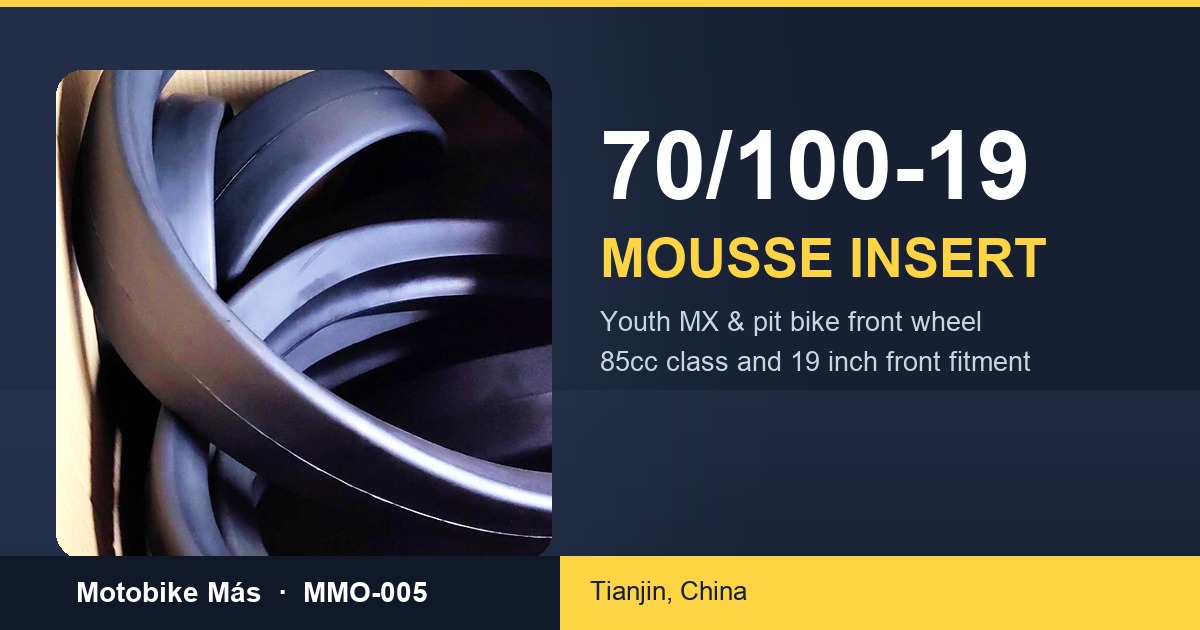
について 70/100-19 is the narrow, small-rim front wheel that sits at the front of a junior motocross bike, and it is the one wheel on that machine whose failure the rider cannot ride out of. A closed-cell nitrile rubber insert cut to that one tire carries the load the compressed air would otherwise carry, so a rock under the front wheel or a square edge on a landing does not take the steering away, and it removes up to 40% of the rotating mass that a tube plus a heavy-duty rim lock would put on the front of the bike.
Motobike Más builds the 70/100-19 Front Wheel Motorcycle Mousse (SKU MMO-005) in its own Tianjin factory, published in three density grades — Soft, Medium and Standard — with an effective pressure equivalent of 8–12 psi and a published unit weight of approximately 0.9–1.1 kg. It is the standard front fitment on the 85cc class and on 125cc and 155cc pit bikes, and it pairs with the 90/100-16 rear on the same machines. This guide covers the specifications, the density selection for junior rider weights, how it differs from a full-size front, the machines it fits, service life and how distributors order it.
最終更新日: 2026年11月19日。. データ出典: the published Motobike Más specifications for MMO-005, the factory’s published fitment, density, pressure and lifespan tables, and the factory’s size and certification documentation. Figures shown as “≈” are calculated from the published tyre size designations rather than measured by the factory.
A 70/100-19 is a 70 mm section width on a 100% aspect ratio, which works out at a 70 mm sidewall and an overall diameter of roughly 623 mm on a 19 inch rim. It is the narrowest and the smallest of the three full-size-category front sizes the factory publishes, and that narrowness is the whole design brief: a 70 mm front tire puts less rubber on the ground than an 80 mm or 90 mm front, which makes the bike lighter and quicker to turn but also gives it less grip.
The front wheel is where that trade-off matters more than anywhere else on the bike. A rear tire that lets go costs a junior rider time; a front tire that lets go costs them the ability to steer, on a small machine with a young rider on it, which is the single most dangerous failure in the sport. The insert is what removes that failure mode entirely, because there is no air chamber left inside the carcass to lose.
What the insert does not do is change the size of the tire. A 70/100-19 insert is cut for a 70 mm section width on a 100% aspect ratio on a 19 inch rim, and it will not seat correctly in an 80/100-21 or a 90/90-21 tire even though all three run on the same or a similar rim diameter. The fitting method is in the ムースインサートの取り付けガイド, and the rear that pairs with this front on the 85cc class is covered in the 90/100-16 youth rear mousse guide.
Read off the sidewall, 70/100-19 means a 70 mm section width, a 100% aspect ratio and a 19 inch rim diameter. The section width is how much rubber the tire puts on the ground; the aspect ratio is how tall the sidewall is as a percentage of that width. At 100% the two numbers are the same, giving a 70 mm sidewall and an overall diameter of roughly 623 mm.
That overall diameter is the number worth checking against the rear of the same bike. The 90/100-16 junior rear works out at roughly 587 mm, so a junior bike typically runs a front about 36 mm taller in overall diameter than its rear. That is the reverse of the full-size convention, where a 21 inch front and a 19 inch rear come out within about 14 mm of each other, and it is why the gearing on a junior machine is set for a front that is the larger wheel.
| データポイント | 価値 | ステータス |
|---|---|---|
| サイズの表記 | 70/100-19 — 70 mm section, 100% aspect ratio, 19 in rim | 公開日 |
| SKU | MMO-005 | 公開日 |
| 密度等級 | ソフト/ミディアム/スタンダード | 公開日 |
| 単位重量 | Approximately 0.9–1.1 kg | 公開日 |
| 有効圧力相当値 | グレードに応じて8~12 psi | 公開日 |
| 耐用年数 | 200~500レーシングマイル | 公開日 |
| 回転質量の低減 | チューブ1本に対して最大40%に加え、頑丈なリムロック | 公開日 |
| 原産国 | 中国・天津 | 公開日 |
| バッチの寸法公差 | 製造ロットごと | ご要望に基づき確認済み |
| バッチの内部密度許容誤差 | 製造ロットごと | ご要望に基づき確認済み |
| 現在のグレードの名称とライダーの体重区分 | SKUあたり | ご要望に基づき確認済み |
| サイズ | セクションの幅 | アスペクト比 | サイドウォールの高さ | リム径 | 全径 |
|---|---|---|---|---|---|
| 70/100-19 — this size | 70 mm | 100% | 約 70 mm | 19インチ | 約 623 mm |
| 90/100-16 — typical youth rear | 100 mm | 100% | 約 100 mm | 16インチ | 約 587 mm |
| 80/100-21 — full-size MX front | 80 mm | 100% | ≈ 80 mm | 21 in | ≈ 693 mm |
| 90/90-21 — full-size enduro front | 90 mm | 90% | ≈ 81 mm | 21 in | ≈ 695 mm |
| 100/90-19 — ナロー・フルサイズ・リアタイヤ | 100 mm | 90% | 約 90 mm | 19インチ | 約 663 mm |
「≈」の値は、公表されているサイズ表記から算出されたものです。サイドウォールの高さは断面幅にアスペクト比を掛けたものであり、全径はリム径にサイドウォールの高さの2倍を加えたものです。これらはサイズ同士を比較する際に役立ちますが、メーカーによる実測値ではありません。実測寸法については、ご要望に応じてメーカーが確認いたします。 公表されているすべてのサイズに関する完全な直径表は、 ムースインサートのサイズガイド.
This size is published in three named density grades — Soft, Medium and Standard — and each grade comes with a published effective pressure equivalent and a published rider-weight band. On a youth bike that combination is unusually useful, because the range of rider weights on this size is narrow enough that a buyer who does not have the bands to hand will fit the wrong grade to a child.
Why the grade matters this much on a front wheel comes down to steering response. The front is the wheel the rider is actually tuning through every corner, and the foam decides whether the tire conforms to the ground or holds its shape over it. Too firm and the tire bridges over bumps rather than settling onto them, the front goes light over the crest and the rider is left guessing at what the bike is doing. Too soft and the insert gives up early, the shape collapses under load and the steering goes vague in exactly the place the rider needs precision.
| 密度等級 | 有効圧力相当値 | 公開済みの地形に関するガイダンス | 公表されているライダー体重区分 |
|---|---|---|---|
| ソフト | 8~10 psi | Mud, sand, loam and wet conditions | 50kg未満 |
| ミディアム | 9~11 psi | さまざまな地形に対応、万能型 | 50–70 kg |
| 標準 | 10~12 psi | Rocky, hard-packed, desert and high-speed | 70kg以上 |
The published bands for this size are materially different from the full-size range, and that is the single most important line in the table. A rider under 50 kg is specified for the Soft grade on the 70/100-19, where the same named soft grade on the 80/100-21 or the 90/90-21 is specified for riders under 70 kg. A dealer who keeps one soft-grade shelf across all three front sizes is fitting a foam roughly 40% too firm for the youngest riders in the shop.
The published terrain guidance follows the rider weight rather than the other way round: Soft for mud, sand, loam and wet conditions, Medium for mixed terrain and all-around use, Standard for rocky, hard-packed, desert and high-speed riding. The grade is chosen for the rider and the terrain, and the tire pressure is then set separately from the bike’s own guidance — they are different settings, and moving one does not move the other. Current grade naming and band boundaries are confirmed by the factory on request, and the naming convention used across the whole range is set out in the ムースインサートのサイズガイド.
Three front widths cover most of the off-road market, and none of them is a substitute for another. The 70/100-19 is the narrow, small-rim front size; the 80/100-21 and the 90/90-21 are the full-size fronts. A mousse is size-specific and cut for one tire, so the number on the sidewall is the only input that matters.
| 仕様 | 70/100-19 | 80/100-21 | 90/90-21 |
|---|---|---|---|
| セクションの幅 | 70 mm | 80 mm | 90 mm |
| アスペクト比 | 100% | 100% | 90% |
| リム径 | 19インチ | 21 inch | 21 inch |
| 代表的な用途 | Youth motocross, pit bike and lightweight off-road front | Motocross and supercross front | Enduro, trail and off-road front |
| Published soft-grade rider weight, by size | 50kg未満 | 70kg未満 | 70kg未満 |
| ムースの単位重量 | Approximately 0.9–1.1 kg | Approximately 0.9–1.1 kg | Approximately 1.0–1.2 kg |
| Steering character | Lightest and quickest to turn, least stable at speed | ステアリングの操作感が軽くなり、ターンインが速くなる | フロントのグリップが向上し、ステアリングの重さがわずかに増した |
Two lines in that table decide the question.
The first is rider weight, and it is the line most often missed. The published soft grade on the 70/100-19 is specified for riders under 50 kg, against under 70 kg on both full-size fronts. The same named grade, applied to a different population, is a firmer foam than the one the junior rider needs.
The second is steering character, and it is where the narrow section width earns its place. A 70 mm front is the quickest of the three to turn in, which on a junior bike with a rider under 50 kg on it is exactly the right characteristic, because the bike needs to be rotated quickly in the tight rhythm sections a youth track is built from. What it gives up is grip at the limit, and on hard-packed or fast terrain the 80/100-21 front is the more stable choice.
There is one further practical difference that is not about the tire at all, and it catches out parents and dealers alike. The 70/100-19 runs on a 19 inch rim while both full-size fronts run on 21 inch, and the difference is not cosmetic: the 21 inch front has about 70 mm more overall diameter and about 11 mm more sidewall height. A 21 inch front absorbs a square edge that a 19 inch front transmits to the rim and the rider’s arms. That is the trade the 80/100-21 and the 90/90-21 exist to make, and it is the reason the 70/100-19 is a youth and pit bike size rather than a full-size one.
| クラス | モデル |
|---|---|
| Youth motocross | Kawasaki KX85 and KX100, KTM 85 SX and 105 SX, Husqvarna TC 85, Yamaha YZ85, Honda CRF150R on some model years, Suzuki RM85, GasGas MC 85 |
| Pit bike and mini motocross | Honda CRF110F aftermarket builds, SSR 125cc and 140cc, YCF 125cc and 155cc, Pitster Pro 125cc and 155cc, Kayö 125cc, Thumpstar 125cc and 140cc, aftermarket 19 inch front wheel conversions |
| Lightweight off-road and dual-sport | Honda CRF250F on selected model years with a 19 inch front, Yamaha TT-R230 on selected model years, Suzuki DR200SE on selected model years, small-displacement enduro and trail bikes |
The 85cc class is the core of this size, and the KTM 85 SX and the 105 SX, the Husqvarna TC 85 and the Yamaha YZ85 are the machines that fill a youth dealer’s shelf. The pit bike group is the second half of the market, and it is a much larger half than the 65cc class because pit bikes are used year-round rather than in a season.
The last group is the one that needs checking rather than assuming. A small number of lightweight off-road and dual-sport machines were built with a 19 inch front rim — the Honda CRF250F on selected model years, the Yamaha TT-R230 on selected model years and the Suzuki DR200SE on selected model years — and those are the cases where a 70/100-19 front is the factory fitment rather than a youth fitment. On those machines the rider weight bands on this size still apply, which is why the published soft-grade band on the 70/100-19 starts at under 50 kg while a full-size front’s does not.
For a distributor, the practical advice is the same as for every size: read the size off the tire. The published list above covers the standard fits, and the factory confirms any specific machine on request.
The argument for mousse on the front is not theoretical. These are the practical differences a race team, a pit crew or a parent’s customer feels.
| 因子 | ムースのフィリング | インナーチューブ |
|---|---|---|
| パンク防止 | 完全密閉型 — 空気が漏れるような空間がありません | Vulnerable to pinch flats and punctures |
| ステアリングの精度 | Consistent from first practice to last moto | Changes with pressure, temperature and altitude |
| 回転質量 | 下部 — チューブなし、リムロックも軽量化 | より高い |
| フロントエンドの安全性 | No sudden loss of steering control | Sudden loss of steering control on a front flat |
| メンテナンス | 一度インストールすれば、それ以降は不要です | 乗車前の空気圧チェック |
| 再利用性 | Transfer to a new tire if still serviceable | Replaced at every tire change |
| 地形への適応性 | Fixed by the density grade chosen | Adjustable through pressure |
| インストール | Moderate — the same technique as the rear | もっと簡単 |
Two rows in that table are the ones that decide the question on a junior machine.
The first is front-end safety, and it is stated plainly in the published comparison: a front flat with a tube means sudden loss of steering control, and a front flat with a mousse means there is no steering to lose because the tire has not lost its structure. On a bike where the rider weighs 40 kg and the machine weighs a fraction of what the rider is used to, that difference is the whole argument.
The second is steering precision. A tube’s pressure drifts with temperature and altitude over a race, so the front that behaved in practice is not necessarily the front that behaves in the race. A mousse holds the carcass behaviour steady for the whole life of the tire, which on a junior bike matters as much as it does on a full-size one — and on a full-size one the rider has the experience to adapt, which is not always true of a nine-year-old on an 85cc.
The general comparison across sizes, including the rear-wheel cases and the cost side of the argument, is in ムースインサートとインナーチューブの比較, 、および代替となる独立気泡システムについては、以下で比較されている。 ムース対Tublissシステム.
The published specification for this size is unusual in that it sets the front insert against the rear insert directly, and the comparison is worth reading before a buyer decides whether to fit one or both.
| アスペクト | Front mousse (70/100-19) | Rear mousse |
|---|---|---|
| Primary demand | Steering precision and bump absorption | Traction and torque transmission |
| Weight impact | ステアリングフィールにとって極めて重要 | 加速に不可欠 |
| Heat generation | Lower — less braking and acceleration load | Higher — driving load |
| Flat consequence | 操舵制御の即時喪失 | やる気の低下、対処可能 |
| Typical lifespan | 通常、リアよりも長い | 負荷が高いため、長さが短くなっています |
That table explains the asymmetry that makes the front the more expensive decision of the two. The rear insert carries drive torque and the engine’s power through the tire for the whole of the run, so it generates more heat and wears faster; the front takes braking and cornering loads, generates less heat and usually outlives the rear. The consequence of a failure is also asymmetric in the opposite direction: a rear that goes down costs the rider time and the bike can still be steered away, while a front that goes down costs the rider control.
Which is why the usual upgrade sequence on a junior bike runs front first. A rear flat ends a run; a front flat ends a rider’s confidence in a way that takes more than one good race day to undo. The pair that goes together on the 85cc class is this front with the 90/100-16 rear, and both run on the same production line with the same tooling.
The one place this comparison is not a straight win is weight. The published unit weight of the 70/100-19 is approximately 0.9–1.1 kg, and the published rotating-mass reduction against a tube plus a heavy-duty rim lock is up to 40% on both wheels — the absolute saving is smaller at the front than the rear, because the front wheel is the lighter one to begin with, but it is at the end of the bike where mass is felt most in a slow turn-in.
ムースインサートには、石油系潤滑剤を絶対に使用しないでください。. Petroleum products degrade nitrile rubber, and a degraded insert is a liability, not a saving. Use water-based mousse lubricant only, on both the insert and the bead seat of the rim.
一般的な工程――ビード座面の準備、潤滑剤の塗布、第1ビード、第2ビード、最終座付け、およびプロファイルを形成する加圧サイクル――は、以下の ムースインサートの取り付けガイド そして、このサイズに対してもそのまま適用されます。.
Check the rim width before the tire goes on. A 19 inch rim carrying a 70 mm section width leaves more rim wall than the tire needs if the tire is mounted close to the edge of the rim, and a forced insert sits off-centre. That shows up as a front end that never quite settles, and it is worth noting that on a narrow front tire it is easier to miss than on a wide one, because the gap left by the sidewall is less obvious to look at.
Inspect the insert at every refit. A junior wheel is rebuilt often — between race days, and often more than once in a race day. Every rebuild levers a bead back over a rim, and that is the moment an insert is most likely to be pinched at the bead and to take a compression set that cannot be seen from the outside. Look at the insert each time the wheel is stripped rather than trusting it from the last time it was fitted, and treat any insert that has been levered over a bead as needing an inspection before it goes back in.
Motobike Más publishes 200–500 racing miles as the typical service life for this size. On a youth bike or a pit bike the honest unit is sessions rather than miles, because a small rider covers very little ground in a race day and a pit bike spends most of its life on a short track.
| ユースケース | 地形 | 予想寿命 | ムース1個あたりのタイヤ本数 |
|---|---|---|---|
| モトクロス(プロ) | 整備されたトレイル、固く締まった雪面 | 30~60時間 | タイヤ1本から2本 |
| モトクロス(アマチュア) | 変化に富んだコースコンディション | 50~80時間 | タイヤ2~3本 |
| エンデューロ(プロ) | テクニカルなシングルトラック、岩、根 | 40~70時間 | タイヤ1本から2本 |
| エンデューロ(中級) | 混合トレイル | 60~100時間 | タイヤ2~3本 |
| ハードエンデューロ | 険しい岩場、丸太、急な登り | 25~50時間 | タイヤ1本 |
| 砂漠レースとラリー | 高速・悪路走行 | 30~60時間 | タイヤ1本から2本 |
| トレイルライディング(カジュアル) | 整備されたトレイル、防火道路 | 80~150時間 | 3~5本のタイヤ |
| レンタル車両 | 混合コンディション | 60~120時間 | 2本から4本のタイヤ |
A front insert generally outlives a rear insert on the same machine, and the reason is load rather than geometry: the front wheel absorbs braking energy and cornering loads, while the rear carries drive torque and the engine’s power through the tire for the whole event. A front insert also works against less heat, and heat is what ages closed-cell foam fastest. The published comparison for this size makes the same point, and the full front-versus-rear breakdown above sets out why.
The replacement criteria are the same as for the rest of the range: replace when the mousse feels noticeably softer or spongy compared with new, when there are visible tears, chunks missing or deformation, when the steering feel goes vague and front-end confidence drops in the corners, or when it has been overheated. A mousse should be warm, not hot, and persistent overheating is not recoverable. Storage matters as much as riding conditions — cool, dry, out of direct sunlight, never compressed or folded, and away from ozone sources such as electric motors and welding equipment — with a published shelf life of 3–5 years in sealed packaging. The full criteria across the range are on the ムースインサートのサイズガイド そして、その ムースインサートの耐用年数ページ.
Motobike Másは、天津市南開区にある自社工場でムースを製造しており、その敷地には50,000 m²の生産フロア、倉庫、研究開発スペースが設けられています。同社の 工場内の全貌 この製品ラインナップを支える生産ライン、保管システム、品質管理体制を紹介しています。.
The 70/100-19 is cut as a 19 inch, 70 mm front insert and carries the same inspection regime as the rest of the range: density testing, compression recovery testing, heat resistance testing, dimensional inspection and structural integrity verification before packing. Dimensional consistency is the check that matters most on this size, because a narrow 70 mm insert has to hold its profile tightly for the tire’s contact patch to stay predictable on a bike whose rider is frequently light on the front end. The full inspection regime is described in the 品質管理プロセスの実地確認.
The 70/100-19 is supplied as a made-to-order factory line rather than from finished-goods stock. The terms that apply across the range — the minimum set per order and confirmed on request, standard OEM production at 15–30 days depending on quantity and customization, pre-production samples for evaluation, and shipping by sea on FOB Tianjin terms, by air freight or DDP — are published together on the ムースインサートのサイズガイド, その 卸売購入ガイド そして、その OEMおよびODM製造 ページ。.
For a youth retailer or a pit bike distributor, the useful point in this size is the pairing rather than the minimum. The 70/100-19 front and the 90/100-16 rear are the standard combination on the 85cc class, they run on the same production line with the same tooling, and they can be combined on a single purchase order and shipped together. A customer who buys a junior front usually needs the rear in the same order, and the front is the one that is easier to leave off a first order — which is exactly why it is the one that ends up being bought separately at full price later.
Private-label production on this size is available with custom branding, packaging and colours, and with custom density formulations including front-specific formulations, which is what a youth programme running under its own brand usually asks for.
The 70/100-19 front tire size is used on youth motocross bikes in the 85cc class, including the Kawasaki KX85 and KX100, KTM 85 SX and 105 SX, Husqvarna TC 85, Yamaha YZ85 and Suzuki RM85, and on 125cc and 155cc pit bikes including the SSR, YCF, Pitster Pro, Kayo and Thumpstar platforms. It also appears on a small number of lightweight off-road and dual-sport machines built with a 19 inch front rim, such as the Honda CRF250F, Yamaha TT-R230 and Suzuki DR200SE on selected model years.
70/100-19 is a front wheel tire size. It is the narrow, small-rim front fitment used on the 85cc class and on pit bikes, and it is never a rear size: a junior bike that runs a 70/100-19 front normally runs a 90/100-16 rear, which is the reverse of the full-size convention where the front is the larger wheel.
Three grades are published for this size: Soft, Medium and Standard, each with its own effective pressure equivalent and rider-weight band. The Soft grade is published for riders under 50 kg on mud, sand, loam and wet conditions at 8 to 10 psi. The Medium grade is published for riders 50 to 70 kg on mixed terrain and all-around use at 9 to 11 psi. The Standard grade is published for riders over 70 kg on rocky, hard-packed, desert and high-speed riding at 10 to 12 psi. These bands differ from the full-size fronts, where the soft grade starts at under 70 kg, so a grade should not be carried across between sizes.
The published effective pressure equivalent for this size is 8 to 12 psi depending on the grade selected, against the 12 to 18 psi typically used for a tube setup on the same off-road tire. The published rider-weight table puts 8 to 10 psi on the Soft grade for riders under 50 kg, 9 to 11 psi on the Medium grade for 50 to 70 kg, and 10 to 12 psi on the Standard grade for riders over 70 kg. The mousse grade and the tire pressure are separate settings, and a 70/100-19 front and a full-size front on the same bike do not necessarily run the same tire pressure.
Motobike Mas publishes 200 to 500 racing miles as the typical service life for the 70/100-19. A front insert generally outlives a rear insert on the same machine, because the front carries braking and cornering loads while the rear carries drive torque and generates more heat, and heat is what ages closed-cell foam fastest. On a junior bike or pit bike the more useful unit is the number of sessions rather than the distance.
You can, and on a junior machine the front is often the right place to start, because a front flat with a tube means sudden loss of steering control rather than just a lost run. The trade is that the rear insert on this size wears faster than the front, because it carries the drive torque and generates more heat. Many riders fit the front first and add the rear after the first race.
The technique is the same in both cases, including the rule that only water-based mousse lubricant may be used, because petroleum products degrade nitrile rubber. Two points are worth noting on the front specifically. Check the rim width against the tire fitment marking before mounting, because a narrow 70 mm tire leaves a gap that is easy to miss, and an insert forced into too narrow a rim sits off-centre and makes the steering feel vague in every corner. And inspect the insert at every rebuild rather than trusting it from the last session, because a bead levered over a rim during a race-day rebuild is the most common way an insert picks up a compression set.
Yes. The published unit weight for the 70/100-19 insert is 0.9 to 1.1 kg, against roughly 400 to 600 g for an inner tube of the same size. The extra mass sits at the wheel, but the mousse still removes up to 40% of the rotating mass a tube plus a heavy-duty rim lock would put on the same end of the bike, so the net effect at the front wheel is lighter than the tube setup it replaces.
The minimum for the 70/100-19 is set per order and confirmed by the factory on request, because this size is made to order rather than pulled from finished-goods stock. Standard OEM production typically runs 15 to 30 days depending on quantity and customization, pre-production samples are available for evaluation, and shipping is by sea on FOB Tianjin terms, by air freight or DDP. Because the 70/100-19 and the 90/100-16 share one production line and one set of tooling, the junior front and rear pair can travel on a single purchase order.
Motobike Mas manufactures tires and mousse inserts under ISO 9001:2015 quality management, to DOT and ECE production standards. Every 70/100-19 insert also passes density, compression recovery, heat resistance, dimensional and structural integrity verification before packing, with dimensional consistency the check that matters most on a narrow front size, where the profile of the tire depends on the profile of the foam inside it. The certification documentation is on the motorcycle tire certifications page and the inspection regime in the quality control walkthrough.
The 70/100-19 Front Wheel Motorcycle Mousse (SKU MMO-005) is produced on the Motobike Más line in Tianjin and supplied to dealers, distributors, race teams and aftermarket brands worldwide. It is available in Soft, Medium and Standard densities, with a published unit weight of approximately 0.9–1.1 kg and an effective pressure equivalent of 8–12 psi depending on the grade selected.
Ask for the current minimum, the density mix and the lead time on the 70/100-19, or take a set of pre-production samples before placing a bulk order. Youth retailers can combine the 70/100-19 front with the 90/100-16 youth rear on one purchase order, since the two are produced on the same line with the same tooling, and private-label production with front-specific density formulations is available on this SKU.
について 70/100-19 product page 完全な仕様が記載されており、 工場の問い合わせページ 仕様に関する要望を直接受け付けています。若者向けラインナップを展開するディーラーも、以下の ムースインサートのサイズガイド to place the junior front against the full-size range, and the ISO 9001、DOTおよびECE認証に関する文書 for the paperwork a youth programme needs.
80/100-21 Mousse Insert | Motocross Front Fitment Guide は次のように述べている:
[…] insert, cut to its own tire, and each needs its own front mousse. Below that full-size range, the 70/100-19 youth MX and pit bike front mousse covers the 85cc class and 19 inch pit-bike […]
90/100-16 キッズ・ムース | ミニダートバイク用リアタイヤ適合ガイド は次のように述べている:
[…] What the insert does not do is change the size of the tire. A 90/100-16 insert is cut for a 100 mm section width on a 100% aspect ratio on a 16 inch rim, and it will not seat correctly in a 70/100-19 or a 100/90-19 tire. The fitting method is in the mousse insert installation guide, and the youth front that pairs with this rear is covered in the 70/100-19 youth front mousse guide. […]