
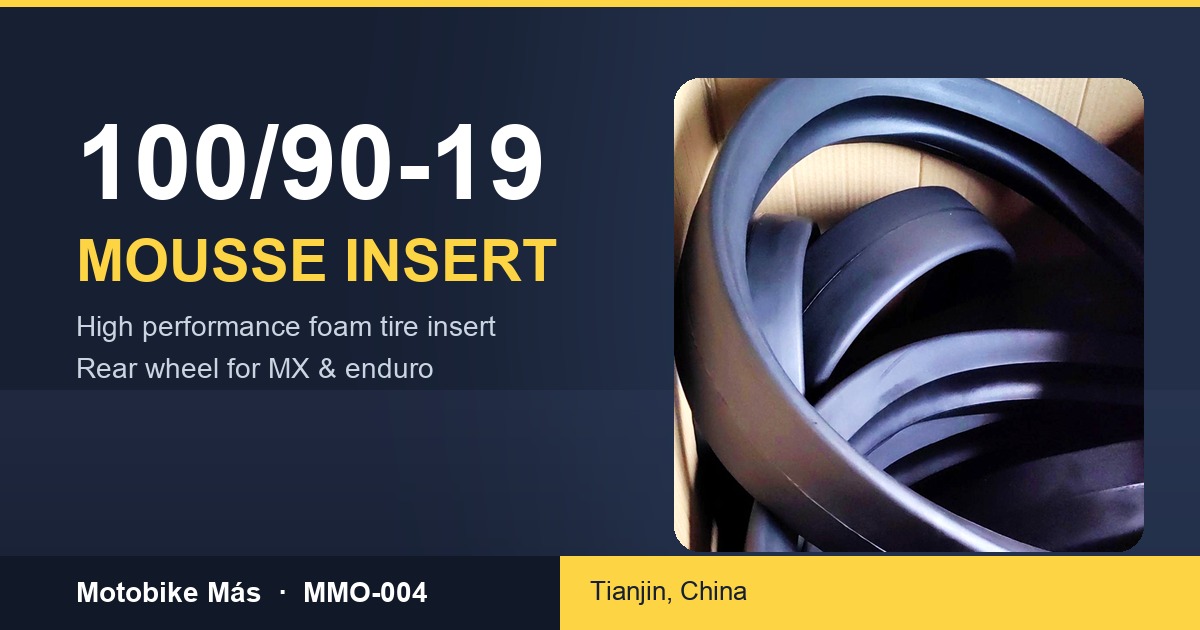
Between the two full-size 19 inch rear options, the 100/90-19 mousse insert is the one built for a bike that changes direction. A 100/90-19 is a 100 mm section width on a 90% aspect ratio, which gives a 90 mm sidewall and an overall diameter of roughly 663 mm on a 19 inch rim — 18 mm smaller in overall diameter than the wider rear on the same rim, and correspondingly lighter at 1.1–1.4 kg.
Those numbers are the whole argument for the size. Less rubber on the rear means less mass to accelerate and decelerate every time the bike rotates, and less mass at the far end of the machine means the bike rotates more willingly when the rider asks it to. On a track built from tight sections, or on a trail that keeps changing its mind about which way it goes next, that is the difference between a bike that feels alive and one that feels like it is being asked to turn.
Motobike Más builds the 100/90-19 High Performance Motorcycle Mousse (SKU MMO-004) in its own Tianjin factory, in three density grades — Soft, Medium and Standard — with an effective pressure equivalent of 8–12 psi. The insert is a closed-cell nitrile rubber tube that carries the structural load the compressed air would otherwise carry, so a rock, a root or a thorn cannot deflate the rear wheel, and it removes up to 40% of the rotating mass a tube plus a heavy-duty rim lock would put on the back of the bike. The tire around it is still inflated with air in the normal way: the mousse provides the structure, and the air still sets the profile, the grip and the rolling resistance.
最終更新日: 2026年11月19日。. データ出典: the published Motobike Más specifications for MMO-004, the factory’s published fitment, density, pressure and lifespan tables, and the factory’s size and certification documentation. Figures shown as “≈” are calculated from the published tyre size designations rather than measured by the factory.
A 100/90-19 is a 100 mm section width on a 90% aspect ratio, which works out at a 90 mm sidewall and an overall diameter of roughly 663 mm on a 19 inch rim. It is the narrow-profile rear, and the narrowness is what defines it: 100 mm of rubber on the ground against the 110 mm of the 110/90-19, on the same rim diameter, with the same aspect ratio.
Less rubber on the rear means less rotating mass and a quicker change of direction, and the rear is where that matters for a light bike on a technical track. The published unit weight for this insert is approximately 1.1–1.4 kg against 1.2–1.5 kg for the wider 110/90-19, and the section width is 10 mm narrower. Both of those move in the same direction: the narrower rear rotates more easily and the bike rotates with it.
What the insert does not do is change the size of the tire. A 100/90-19 insert is cut for a 100 mm section width on a 90% aspect ratio on a 19 inch rim, and it will not seat correctly in a 110/90-19 or a 120/90-18 tire. The full size-by-size compatibility picture is on the ムースインサートのサイズガイド, and the fitting method is in the ムースインサートの取り付けガイド.
The size is defined by three numbers: a 100 mm section width, a 90% aspect ratio, and a 19 inch rim diameter. Put together they produce a 90 mm sidewall and an overall diameter of roughly 663 mm — and that last figure is the one that catches people out, because it is 18 mm smaller than the wide rear on the same rim.
The consequence reaches further than the tire. The front of the same bike typically runs 21 inch — a 90/90-21 at roughly 695 mm overall or an 80/100-21 at roughly 693 mm — so on this rear the front sits about 30 mm taller, where the wide rear leaves only about 12–14 mm. A bike set up around one rear diameter is set up around the other when it changes, and riders who move between the two sizes usually notice the bike’s gearing and axle height before they notice anything about the tire itself.
| データポイント | 価値 | ステータス |
|---|---|---|
| サイズの表記 | 100/90-19 — 100 mm section, 90% aspect ratio, 19 in rim | 公開日 |
| SKU | MMO-004 | 公開日 |
| 密度等級 | ソフト/ミディアム/スタンダード | 公開日 |
| 単位重量 | 約1.1~1.4 kg | 公開日 |
| 有効圧力相当値 | グレードに応じて8~12 psi | 公開日 |
| 耐用年数 | 200~500レーシングマイル | 公開日 |
| 回転質量の低減 | チューブ1本に対して最大40%に加え、頑丈なリムロック | 公開日 |
| 原産国 | 中国・天津 | 公開日 |
| バッチの寸法公差 | 製造ロットごと | ご要望に基づき確認済み |
| バッチの内部密度許容誤差 | 製造ロットごと | ご要望に基づき確認済み |
| 現在のグレードの名称とライダーの体重区分 | SKUあたり | ご要望に基づき確認済み |
| サイズ | セクションの幅 | アスペクト比 | サイドウォールの高さ | リム径 | 全径 |
|---|---|---|---|---|---|
| 100/90-19 — this size | 100 mm | 90% | 約 90 mm | 19インチ | 約 663 mm |
| 110/90-19 — wide rear | 110 mm | 90% | 約 99 mm | 19インチ | 約 681 mm |
| 120/90-18 — ラリー用リアタイヤ | 120 mm | 90% | 約 108 mm | 18インチ | 約 673 mm |
| 90/100-16 — junior rear | 100 mm | 100% | 約 90 mm | 16インチ | 約 587 mm |
| 90/90-21 — typical front | 90 mm | 90% | ≈ 81 mm | 21 in | ≈ 695 mm |
| 80/100-21 — MX front | 80 mm | 100% | ≈ 80 mm | 21 in | ≈ 693 mm |
「≈」の値は、公表されているサイズ表記から算出されたものです。サイドウォールの高さは断面幅にアスペクト比を掛けたものであり、全径はリム径にサイドウォールの高さの2倍を加えたものです。これらはサイズ同士を比較する際に役立ちますが、メーカーによる実測値ではありません。実測寸法については、ご要望に応じてメーカーが確認いたします。 公表されているすべてのサイズに関する完全な直径表は、 ムースインサートのサイズガイド.
This size is published in three named density grades — Soft, Medium and Standard — and each grade comes with a published effective pressure equivalent and a published rider-weight band. On the narrow rear, the grade decides how the tire behaves over rough ground and how long it lasts, and both matter because this size is chosen for agility rather than for straight-line stability.
| 密度等級 | 有効圧力相当値 | 公開済みの地形に関するガイダンス | 公表されているライダー体重区分 |
|---|---|---|---|
| ソフト | 8~10 psi | Mud, sand, loam and wet conditions | 75kg未満 |
| ミディアム | 9~11 psi | さまざまな地形に対応、万能型 | 75–90 kg |
| 標準 | 10~12 psi | Rocky, hard-packed, desert and high-speed | 90kg以上 |
The published rider-weight bands here are identical to the other full-size rears, and that is worth saying plainly because it is a common source of confusion: the bands decide which grade a rider should be on, while the size-selection guidance decides which size the bike should be running. Those are two separate questions. The 100/90-19 is published as under 85 kg ideal, against over 75 kg recommended for the wider 110/90-19, so a rider in the 75–85 kg band sits on the Medium grade either way but is the better match for the narrow rear. Full comparison below; the naming convention used across the range is set out on the ムースインサートのサイズガイド.
Two 19 inch rear sizes cover almost the entire full-size off-road market, and choosing between them is the most common rear specification decision a distributor makes. The 100/90-19 and the 110/90-19 are not two versions of the same part — each size has its own insert, cut to its own tire, and each needs its own rear mousse. Between them they cover nearly every full-size machine sold, which is why most distributors stock both.
| 仕様 | 100/90-19 | 110/90-19 |
|---|---|---|
| セクションの幅 | 100 mm | 110 mm |
| Aspect ratio / rim diameter | 90% / 19 inch | 90% / 19 inch |
| Profile character | Narrower, quicker steering response | より広い範囲での直進安定性 |
| こんな場合に最適 | 軽量なバイク、中級レベルの地形、アグレッシブなコーナリング | Heavy bikes, high-speed riding and deep loam |
| Published rider-weight fit | 85kg未満が理想的 | 75kg以上の方におすすめ |
| ムースの単位重量 | 約1.1~1.4 kg | 約1.2~1.5 kg |
| 密度等級 | ソフト/ミディアム/スタンダード | ソフト/ミディアム/スタンダード |
The published size-selection guidance in that table is the line to work from, and the overlap between the two figures is the interesting part. The 100/90-19 is published as under 85 kg ideal and the 110/90-19 as over 75 kg recommended, so a rider between roughly 75 and 85 kg sits in the zone where either size is defensible. That zone is where the bike and the terrain decide it rather than the rider alone: a 250cc on a tight, flowing track and a 450 on a fast, open surface both fall in it, and they do not want the same rear.
The other line that decides it is the weight. At approximately 1.1–1.4 kg this insert is 100 to 200 g lighter than the 110/90-19, and that mass sits at the very end of the bike where it is felt in every direction change. The narrower rear buys acceleration and agility with grip, which is the correct trade for a light bike on a technical or flowing track, and the wrong trade for a heavy bike, a fast open surface or a deep soft surface where traction is the limiting factor.
There is a third consideration that the table does not show but the geometry does, and it is the one that surprises customers. Because this size has a smaller overall diameter than the 110/90-19 — roughly 663 mm against 681 mm — moving between the two rear sizes changes the bike’s gearing and the height of the rear axle relative to the front. Riders moving from a wide rear to a narrow one often report that the bike feels taller on the pegs and quicker on the throttle, and that is the diameter difference, not the insert. A distributor whose customers move between the two sizes should mention it rather than let them discover it.
For a distributor the practical consequence is that the two sizes serve genuinely different customers rather than being interchangeable stock. The 100/90-19 moves into motocross, technical-track and lighter-rider accounts. The 110/90-19 moves into enduro, cross-country and heavier-rider accounts. Both run on the same production line with the same tooling, so there is no operational reason to carry one and not the other — the reason to carry both is that a customer who arrives with a bike on a 100/90-19 rear cannot be served with a 110/90-19 insert.
Buyers who need only one of the two should check the rear tire size on the machine before ordering. The size is printed on the sidewall, and the ムースインサートのサイズガイド lists every size the factory currently publishes. For the wider wholesale picture, see the 卸売購入ガイド.
| クラス | モデル |
|---|---|
| 250cc motocross | Honda CRF250R, Yamaha YZ250F, KTM 250 SX-F, Husqvarna FC 250, Kawasaki KX250, Suzuki RM-Z250, GasGas MC 250F |
| 450cc motocross | Honda CRF450R, Yamaha YZ450F, KTM 450 SX-F, Husqvarna FC 450, Kawasaki KX450, Suzuki RM-Z450 |
| Enduro / cross-country | KTM 300 XC-W, KTM 350 EXC-F, KTM 500 EXC-F, Husqvarna TE 300, FE 350, FE 501, Beta RR 300 / RR 350 / RR 430 / RR 480, Sherco SE 300 / SE 500, GasGas EC 250 / EC 300 |
This size appears across the full-size motocross and enduro range, on factory rear setups and on machines that have been set up with a narrower rear profile for tighter terrain or lighter riders. That last group is the commercially interesting one: the machines that run the 100/90-19 as a deliberate choice rather than as the factory default are exactly the customers who understand why the size exists.
The machine population itself overlaps heavily with the 110/90-19. The same 250cc and 450cc motocross platforms appear on both lists, which is normal — a size is fitted to a platform, and the platform can be set up either way. It means the fitment list alone will not settle which rear a customer needs; the tire on the bike is the only reliable answer, and it is printed on the sidewall.
For a distributor the practical consequence is that the 100/90-19 is a size to hold in depth rather than a specialist item to hold thin. It covers the motocross side of the full-size market, and motocross is where the volume is. The why professional off-road teams choose mousse inserts page covers what the race and team buyers on this size are actually buying, and the mousse selection guide for enduro riding covers the terrain side of the choice.
The argument for mousse on the rear is not theoretical. These are the practical differences a race team or a dealer’s customer feels.
| 因子 | ムースのフィリング | インナーチューブ |
|---|---|---|
| パンク防止 | 完全密閉型 — 空気が漏れるような空間がありません | Vulnerable to pinch flats and punctures |
| トラクション | Consistent from the first lap to the last | Changes with pressure, temperature and altitude |
| 回転質量 | 下部 — チューブなし、リムロックも軽量化 | より高い |
| Corner exit | Quicker acceleration out of corners with up to 40% less rotating mass | ベースライン |
| Suspension loading | Less strain on the suspension components | ベースライン |
| メンテナンス | 一度インストールすれば、それ以降は不要です | 乗車前の空気圧チェック |
| 再利用性 | Transfer to a new tire if still serviceable | Replaced at every tire change |
| 地形への適応性 | Fixed by the density grade chosen | Adjustable through pressure |
| インストール | もっと難しい | もっと簡単 |
Two lines in that table carry the weight of the argument on a narrow rear.
The first is rotating mass, and on this size it is the decisive one. The published comparison notes that the mousse setup is lighter than a tube plus a rim lock, and the published rotating mass reduction against that setup is up to 40%. On the narrow rear — the size chosen for agility — removing mass from the far end of the bike is the whole reason it exists, and a tube with a heavy rim lock throws that advantage away before the rider gets on the bike.
The second is traction consistency. A tube’s pressure drifts with temperature through a race, and a rear that changes its footprint as the engine heats up is a rear that changes its traction. The mousse’s terrain behaviour is fixed by the density grade chosen, so the choice is made once at the order and then holds for the whole season. On a technical track where the rider is asking the rear to hook up out of every corner, that consistency is the difference between a rear that works and a rear that works differently in the second half of the race.
The general comparison across sizes, including the front-wheel safety cases and the cost side of the argument, is in ムースインサートとインナーチューブの比較, 、および代替となる独立気泡システムについては、以下で比較されている。 ムース対Tublissシステム.
The 100/90-19 exists because there is a specific type of riding where a narrower rear is the better tool, and it is worth describing that type rather than leaving the choice to a specification table.
On a track that changes direction constantly. A narrow rear has less mass to accelerate and decelerate as the bike rotates, and the rider feels that as a bike that is willing to change direction on the throttle. A wide rear carries 10 mm more rubber and correspondingly more mass, and that mass is what makes a bike feel like it wants to run straight. On a track built from tight rhythm sections — supercross-style, or a wooded enduro trail — that willingness is the difference between a bike that feels alive under the rider and a bike that feels like it is being asked to turn.
On a surface where the tires dig rather than slide. A narrower tire has a smaller contact patch, which means less of it sinks into a soft surface before it finds the layer underneath. That cuts both ways, and the honest version is that on soft ground the narrow rear finds less grip once it does dig, which is why the published guidance for this size still includes soft terrain in the softest grade’s description. The advantage is in the transition — the tire finds grip sooner, so the rear steps out predictably instead of ploughing.
On a light bike, where the weight band matters. The published size-selection guidance puts this size at under 85 kg ideal. That is not the same as the density grade bands, which are the same across the full-size rears, and it is the size statement that does the work here: a bike carrying a rider who is comfortable at the lighter end of the range is better served by the narrow rear, because the wide rear’s extra mass is a larger share of the whole machine.
What the narrow rear gives up is ultimate traction, and the cases where that matters are the deep, soft and fast surfaces that the wide rear exists for. The 110/90-19 wide rear guide sets out that side of the trade in full, and the hard enduro versus desert racing comparison covers the terrain where the extra 10 mm of section width becomes the deciding factor.
Two effects come out of the 10 mm difference in section width, and they compound each other.
The first is mass. The published unit weight for this insert is approximately 1.1–1.4 kg against 1.2–1.5 kg for the 110/90-19, so the narrower rear is 100 to 200 g lighter at the end of the bike. The second is geometry: with a smaller overall diameter of roughly 663 mm against 681 mm, the same engine and the same gearing ratio produce a different final drive speed, and the bike’s gearing ratio effectively changes when the tire diameter changes.
Together they are why a bike on the narrow rear feels quicker out of a corner. The rear accelerates more easily, and the gearing change means the engine is working in a slightly different part of its range at any given road speed. Neither effect is dramatic on its own, and both are easy to feel on a bike that rotates through a corner repeatedly.
The trade is traction at the limit, and it is a real trade rather than a marketing one. A narrower rear has less rubber in contact with the surface, so it reaches its traction ceiling sooner and it spins up more readily under power. On a technical track that is usually a benefit, because the rider is managing the rear in the mid-range rather than at the limit. On a fast, open or soft surface it is not, because there the rear is being asked for everything it has.
There is also a practical consequence for a buyer who is changing rear size on an existing bike. The published specifications do not cover gearing ratios for the two tires, and the factory confirms the current figures on request, but the diameter difference is the published basis for the change: a 100/90-19 rear is roughly 18 mm smaller in overall diameter than a 110/90-19 rear on the same rim. Any machine that has been set up around one of those diameters — gearing, chain length, ride height — is set up around the other when it changes. The ムースインサートのサイズガイド lists the calculated diameters for every published size.
The fitting technique is shared across the range, and the general sequence is written out in the ムースインサートの取り付けガイド. Two things about the lubricant are not negotiable on any size: water-based mousse lubricant only, applied to both the inside of the casing and the insert itself, and never a petroleum-based product, because petroleum degrades nitrile rubber and a degraded insert is a liability rather than a saving.
What is specific to the narrow rear is what happens when the profile is wrong. A 100 mm section on a 19 inch rim leaves more spare rim wall than the wider rear does, which makes it easier to mount without noticing that the tire is sitting outside its fitment marking. The insert then has more room to move, and a mousse that has moved off-centre gives the rider a rear wheel that feels loose rather than one that feels obviously wrong. Reading the fitment marking before the tire goes on costs nothing; diagnosing a vague rear afterwards costs a teardown.
The second specific point is about rebuilds. This is a size that gets rebuilt constantly — a motocross wheel comes apart between races and often more than once in a race day — and every rebuild levers a bead back over a rim. That is where an insert picks up a compression set it cannot be seen to have, and on a narrow profile a set insert changes the way the tire sits on the rim noticeably. Look at the insert each time the wheel is stripped rather than carrying a verdict forward from the last time it was fitted.
Motobike Más publishes 200–500 racing miles as the typical service life for this product, and adds that given the lighter rider weights and lower power outputs typical of this size’s machines, inserts of this type often last longer than on the heavier, wider rear.
On a motocross or enduro bike, life is usually quoted in racing miles rather than hours, because an insert is consumed by track time rather than distance covered on the road — and the hours-based figures quoted elsewhere in the category are a different measure of the same thing, not a competing number.
| ユースケース | 地形 | 予想寿命 | ムース1個あたりのタイヤ本数 |
|---|---|---|---|
| モトクロス(プロ) | 整備されたトレイル、固く締まった雪面 | 30~60時間 | タイヤ1本から2本 |
| モトクロス(アマチュア) | 変化に富んだコースコンディション | 50~80時間 | タイヤ2~3本 |
| エンデューロ(プロ) | テクニカルなシングルトラック、岩、根 | 40~70時間 | タイヤ1本から2本 |
| エンデューロ(中級) | 混合トレイル | 60~100時間 | タイヤ2~3本 |
| ハードエンデューロ | 険しい岩場、丸太、急な登り | 25~50時間 | タイヤ1本 |
| 砂漠レースとラリー | 高速・悪路走行 | 30~60時間 | タイヤ1本から2本 |
| トレイルライディング(カジュアル) | 整備されたトレイル、防火道路 | 80~150時間 | 3~5本のタイヤ |
| レンタル車両 | 混合コンディション | 60~120時間 | 2本から4本のタイヤ |
The practical limit for a motocross customer is often not the mileage but the number of rebuilds. A club racer running six events a season on one pair of tires gets through an insert well before the published mileage, because the insert is removed and refitted far more often than it is ridden. The general replacement and storage criteria that apply across every size are covered in ムース・インサートの寿命 そして how long a motorcycle mousse lasts.
Motobike Más produces mousse in its own Tianjin facility in the Nankai District, covering 50,000 m² of production floor, warehousing and R&D space, and the factory walkthrough この製品ラインナップを支える生産ライン、保管システム、品質管理体制を紹介しています。.
The difficult part of this size is not the foam, it is holding the profile. The 100/90-19 is cut for a 100 mm section on a 19 inch rim, and the whole point of the tire is that its shape stays predictable — a narrow profile that varies by even a little across a batch gives the rider a contact patch that moves from tire to tire, which is precisely the consistency this size is bought for. Dimensional inspection therefore carries the most weight on this SKU, running alongside the density, compression recovery, heat resistance and structural integrity verification that every insert in the range passes before packing.
That consistency is worth more here than on a wider size, because the rider who chooses the narrow rear is usually choosing it for how the bike feels. A batch that varies in profile is not a reject on the factory floor; it is a customer complaint about vague handling that is genuinely hard to trace back. The full inspection regime is described in the 品質管理プロセスの実地確認.
The 100/90-19 is supplied as a made-to-order factory line rather than from finished-goods stock. The terms that apply across the range — the minimum set per order and confirmed on request, standard OEM production at 15–30 days depending on quantity and customization, pre-production samples for evaluation, and shipping by sea on FOB Tianjin terms, by air freight or DDP — are published together on the ムースインサートのサイズガイド, その 卸売購入ガイド そして、その OEMおよびODM製造 ページ。.
The commercial shape of this size is different from the wide rear. The 100/90-19 moves into the motocross side of the market, where accounts are larger in number and smaller in average value, and where an aftermarket brand is frequently competing on the label rather than on the compound. That makes it the size where a private-label programme is most often worth doing: custom branding, packaging and colours are available, along with custom density formulations for accounts that need a specific compound rather than a specific label.
Both full-size rears run on one line with one set of tooling, so the 100/90-19 and the 110/90-19 can travel on a single purchase order — which is usually the cheapest way for a distributor to answer the “which rear?” question for a customer rather than sending them somewhere else for the other size. The other rear sizes in the range, the 120/90-18 そして、その 140/80-18, can be added to the same order.
A rear size, and the narrow one of the two full-size 19 inch rear options. It is fitted across the full-size motocross and enduro platforms, on factory setups and on machines deliberately set up with a narrower rear profile. The published size-selection guidance puts it at under 85 kg ideal, which is the clearest single statement of what the size is for. Front wheels on the same class of bike run 21 inch tires such as the 90/90-21 and the 80/100-21.
Ten millimetres of section width, and the two sizes divide along different lines rather than simply offering more or less of the same thing. The 100/90-19 is narrower, quicker to steer and published as under 85 kg ideal for lightweight bikes, intermediate terrain and aggressive cornering. The 110/90-19 is wider, more stable in a straight line and published as over 75 kg recommended for heavy bikes, high-speed riding and deep loam. The narrow rear is also roughly 100 to 200 g lighter, at 1.1 to 1.4 kg against 1.2 to 1.5 kg, and about 18 mm smaller in overall diameter, so a bike moving between them changes its gearing and axle height as well as its feel.
Soft for riders under 75 kg on mud, sand, loam and wet conditions at 8 to 10 psi, Medium for 75 to 90 kg on mixed terrain and all-around use at 9 to 11 psi, and Standard for over 90 kg on rocky, hard-packed, desert and high-speed riding at 10 to 12 psi. The rider-weight bands here are the same as on the other full-size rears, so the grade is not what distinguishes the two rear sizes. What distinguishes them is the size-selection guidance, and a buyer who wants the narrow rear is usually a rider at the lighter end of the range who values how the bike changes direction.
The published effective pressure equivalent for this size is 8 to 12 psi depending on the grade selected, against the 12 to 18 psi typically used for a tube setup on the same off-road tire, with the band set by the grade: 8 to 10 psi on the Soft grade for riders under 75 kg, 9 to 11 psi on the Medium grade for 75 to 90 kg, and 10 to 12 psi on the Standard grade for riders over 90 kg. The grade and the tire pressure are separate settings, and a narrow rear on a fast track does not necessarily run the same tire pressure as a wide rear on the same bike.
Motobike Mas publishes 200 to 500 racing miles as the typical service life, and notes that given the lighter rider weights and lower power outputs typical of this size’s machines, inserts of this type often last longer than on the heavier rear. For a motocross customer the practical limit is frequently the number of wheel rebuilds rather than the mileage, since the insert comes out and goes back in far more often than it is ridden. The hours-based figures quoted elsewhere in the category measure the same thing rather than being a competing number.
No. A 100/90-19 insert is cut for a 100 mm section width on a 90% aspect ratio, and the 110/90-19 is a wider carcass with a different profile and a different internal volume. The insert will not sit correctly in the wider tire, and forcing it damages the bead and the foam. Nor does a wider insert drop into a narrower tire. Match the insert to the designation printed on the tire, and if the bike is between sizes, check what is actually fitted before ordering.
Yes, at 1.1 to 1.4 kg against roughly 400 to 600 g for an inner tube of the same size. The extra mass sits at the wheel, but this is the size where that matters least, because the published rotating mass reduction against a tube plus a heavy-duty rim lock is up to 40% and the rear tire on this size is already the narrowest and lightest of the full-size range. The net effect at the rear wheel is still lighter than the tube setup it replaces, which is the point: the narrow rear was chosen for how readily the bike changes direction, and a rim lock would work against that.
Water-based mousse lubricant only, on both the inside of the tire casing and the insert itself, and never a petroleum-based product, because petroleum degrades nitrile rubber. Two points are specific to this size. The narrow profile leaves more spare rim wall than the wide rear does, but the tire fitment marking still has to be checked against the rim width before mounting, because an insert forced into too narrow a rim sits off-centre. And the insert should be inspected at every rebuild rather than trusted from the last session.
The minimum is set per order and confirmed by the factory on request, because the range is made to order rather than pulled from finished-goods stock. Standard OEM production typically runs 15 to 30 days depending on quantity and customization, pre-production samples are available for evaluation before a bulk order, and shipping is by sea on FOB Tianjin terms, by air freight or DDP. Because this size moves into the motocross side of the market, private-label production with custom branding, packaging and colours is a common route for it, alongside custom density formulations.
Motobike Mas manufactures tires and mousse inserts under ISO 9001:2015 quality management, to DOT and ECE production standards. Every insert passes density, compression recovery, heat resistance, dimensional and structural integrity verification before packing. On the 100/90-19 the dimensional check carries particular weight, because this size is bought for predictable handling and a profile that varies across a batch is felt as vague rear feedback rather than being rejected at the factory. The certification documentation is on the motorcycle tire certifications page and the inspection regime in the quality control walkthrough.
The 100/90-19 High Performance Motorcycle Mousse (SKU MMO-004) is produced on the Motobike Más line in Tianjin and supplied to importers, distributors, dealers, race teams and aftermarket brands worldwide. It is available in Soft, Medium and Standard densities, with a published unit weight of approximately 1.1–1.4 kg and an effective pressure equivalent of 8–12 psi depending on the grade selected.
Ask for the current minimum, the density mix and the lead time on the 100/90-19, or take a set of pre-production samples before placing a bulk order. This is the size that suits an aftermarket brand competing on the label as well as the compound — custom branding, packaging, colours and density formulations are all available on the OEM route — and it pairs on the same order with the 110/90-19 wide rear, since the two run on one production line.
について 100/90-19 product page 完全な仕様が記載されており、 工場の問い合わせページ takes specification requests directly. The ムースインサートのサイズガイド gives the full size and grade comparison and explains the grade naming conventions used across the range, and the ISO 9001、DOTおよびECE認証に関する文書 covers the file a distributor needs on file.
70/100-19 ムースインサート | ユースMX用フロント適合ガイド は次のように述べている:
[…] cover the full-size rear fitments that the same riders move up to, and the 110/90-19 guide and the 100/90-19 narrower rear profile guide explain when to move a customer from one rear width to the […]
90/100-16 Kids Motocross Mousse: Mini Dirt Bike Rear Fitment Guide - Motobike Más は次のように述べている:
[…] improper fitment, reduced performance and a safety risk. The full-size rears are covered in the 100/90-19 narrower rear profile guide and the 110/90-19 motocross and enduro rear fitment guide, and the complete size reference is in […]
110/90-19 Mousse Insert | Motocross & Enduro Fitment Guide は次のように述べている:
[…] guidance puts this size at over 75 kg recommended, against under 85 kg ideal for the narrower 100/90-19, which is a different dimension from the grade bands above — the bands choose the grade, the […]