
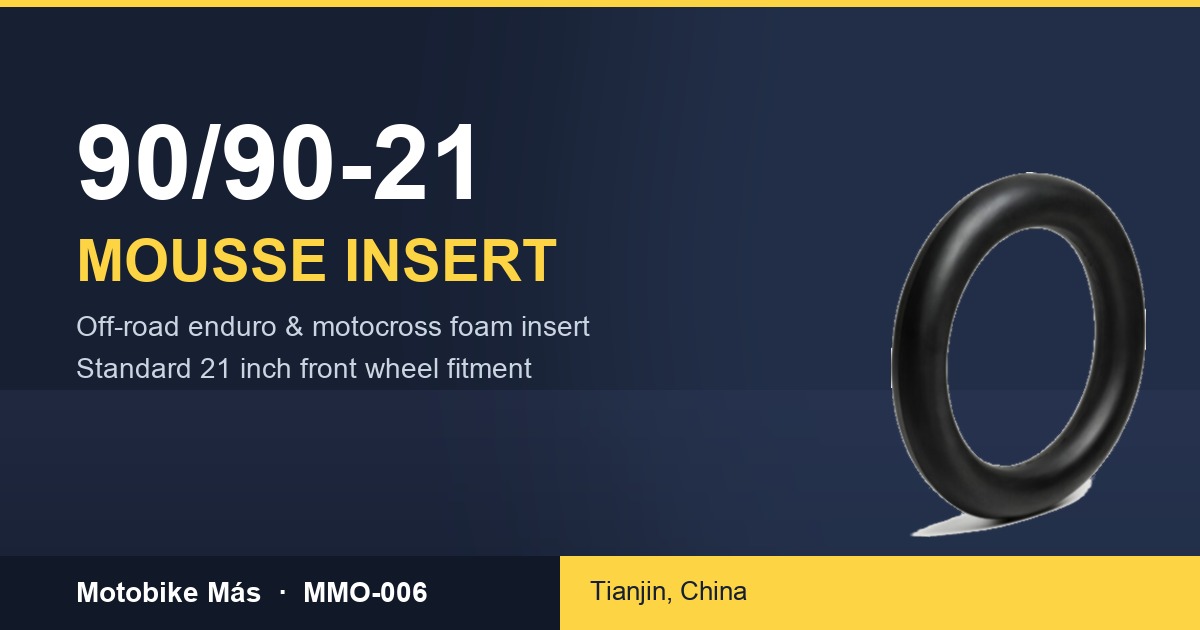
The 90/90-21 is the enduro and cross-country front size, and the foam that goes inside it is a closed-cell nitrile rubber tube cut to that one tire — 90 mm section width, 90% profile, 21 inch rim. Because it carries the load that compressed air would otherwise carry, a square-edged rock, a buried root or a hard landing cannot deflate the front wheel, and the up-to-40% reduction in rotating mass against a tube plus a heavy-duty rim lock is why the front end of a bike feels so different on it. The tire around the insert is still inflated with air in the normal way: the mousse provides the structure, and the air still sets the profile, the grip and the rolling resistance.
Motobike Más builds the 90/90-21 Off-Road Motorcycle Mousse Insert (SKU MMO-006) in its own Tianjin factory. It is the taller of the two full-size 21 inch fronts and the factory default on full-size motocross, enduro and cross-country machines, published in three density grades — Soft, Medium and Standard — so one SKU covers everything from desert racing to technical hard enduro. This guide covers the specifications, the 90/90-21 against the 80/100-21, density selection, the machines it fits, service life and how distributors order it.
最終更新日: 2026年11月19日。. データ出典: the published Motobike Más specifications for MMO-006, the factory’s published fitment, density, pressure and lifespan tables, and the factory’s size and certification documentation. Figures shown as “≈” are calculated from the published tyre size designations rather than measured by the factory.
The 90/90-21 is the taller of the two full-size 21 inch front wheels, and that single fact drives most of the decisions a buyer makes about it. A 90 mm section width on a 90% aspect ratio gives the tire an 81 mm sidewall, and on a 21 inch rim the tire’s overall diameter works out at roughly 695 mm. That extra height compared with the 80/100-21 is what lets the carcass flex over a square-edge rock instead of loading the rim, and it is why enduro and cross-country machines carry a 21 inch front rather than an 18 inch one.
The mousse insert sits inside that carcass and does the job the inner tube would otherwise do. Because there is no air chamber left to lose, a rock, a root or a landing cannot deflate the front wheel — and a front deflation is the most dangerous failure in off-road riding, because it takes the steering away without warning. A 90/90-21 insert also carries the structural load without needing a heavy rim lock, which is where the up-to-40% rotating mass reduction on this size comes from.
What a mousse cannot do is change the size of the tire. A 90/90-21 insert is cut for a 90/90-21 carcass on a 21 inch rim, and it will not seat correctly in an 80/100-21 or a 90/100-21 tire. The size-by-size compatibility rules are set out in the ムースインサートのサイズガイド, and the fitting method is in the ムースインサートの取り付けガイド.
Read off the sidewall, 90/90-21 means a 90 mm section width, a 90% aspect ratio and a 21 inch rim diameter. The section width is how much rubber the tire puts on the ground; the aspect ratio is how tall the sidewall is as a percentage of that width. On this size the two numbers give an 81 mm sidewall and an overall diameter of roughly 695 mm.
That diameter is worth checking against the rear of the same bike. A 110/90-19 rear — the standard rear on the same class of machine — works out at roughly 681 mm, so a 90/90-21 front sits about 14 mm taller than the rear it is paired with. Gearing and speedometer readings are unaffected, because the two wheels are close in overall diameter, but the taller front is why the front end looks visually larger on a 21 inch enduro bike.
| データポイント | 価値 | ステータス |
|---|---|---|
| サイズの表記 | 90/90-21 — 90 mm section, 90% aspect ratio, 21 in rim | 公開日 |
| SKU | MMO-006 | 公開日 |
| 密度等級 | ソフト/ミディアム/スタンダード | 公開日 |
| 単位重量 | Approximately 1.0–1.2 kg | 公開日 |
| 有効圧力相当値 | グレードに応じて8~12 psi | 公開日 |
| 耐用年数 | 200~500レーシングマイル | 公開日 |
| 回転質量の低減 | チューブ1本に対して最大40%に加え、頑丈なリムロック | 公開日 |
| 原産国 | 中国・天津 | 公開日 |
| バッチの寸法公差 | 製造ロットごと | ご要望に基づき確認済み |
| バッチの内部密度許容誤差 | 製造ロットごと | ご要望に基づき確認済み |
| 現在のグレードの名称とライダーの体重区分 | SKUあたり | ご要望に基づき確認済み |
| サイズ | セクションの幅 | アスペクト比 | サイドウォールの高さ | リム径 | 全径 |
|---|---|---|---|---|---|
| 90/90-21 — this size | 90 mm | 90% | ≈ 81 mm | 21 in | ≈ 695 mm |
| 80/100-21 | 80 mm | 100% | ≈ 80 mm | 21 in | ≈ 693 mm |
| 90/100-21 — rally front | 90 mm | 100% | 約 90 mm | 21 in | ≈ 713 mm |
| 110/90-19 — typical rear | 110 mm | 90% | 約 99 mm | 19インチ | 約 681 mm |
| 100/90-19 — narrow rear | 100 mm | 90% | 約 90 mm | 19インチ | 約 663 mm |
| 120/90-18 — ラリー用リアタイヤ | 120 mm | 90% | 約 108 mm | 18インチ | 約 673 mm |
「≈」の値は、公表されているサイズ表記から算出されたものです。サイドウォールの高さは断面幅にアスペクト比を掛けたものであり、全径はリム径にサイドウォールの高さの2倍を加えたものです。これらはサイズ同士を比較する際に役立ちますが、メーカーによる実測値ではありません。実測寸法については、ご要望に応じてメーカーが確認いたします。 公表されているすべてのサイズに関する完全な直径表は、 ムースインサートのサイズガイド.
On the 90/90-21 the aspect ratio does more work than on any other common off-road size, because 90% of a 90 mm section is 81 mm of sidewall. Three things follow from that.
Carcass compliance. A tall sidewall absorbs a square edge by flexing, so the impact energy goes into deforming the sidewall instead of into the rim. On rock ledges and root steps this is the difference between a bump and a bent rim, and it is the reason enduro and cross-country bikes run a 21 inch front rather than an 18 inch one.
Contact patch behaviour. A taller sidewall deflects more under load, so the same tire develops a slightly longer, slightly narrower contact patch at any given pressure. On soft ground that lets the carcass conform to the surface rather than bridging over it, which is what makes the 90/90-21 the natural choice on sand, loam and wet roots.
The price. More sidewall means more rubber and more foam. The published unit weight for this insert is 1.0–1.2 kg, against 0.9–1.1 kg for the 80/100-21 — roughly 100 g of extra rotating mass at the very end of the bike, where it is felt most in slow-turn-in transitions and in the weight of the bike over a rock.
The practical rule that follows is simple. Run the 90/90-21 on loose, soft and technical ground where compliance and grip matter more than turn-in speed, and keep the 80/100-21 for hard-packed motocross where steering response and lap time matter more than rock protection. The 80/100-21 front mousse page sets out that alternative in full, and the サイズガイド lists every size the factory publishes.
This size is published in three named density grades — Soft, Medium and Standard — and each grade comes with a published effective pressure equivalent and a published rider-weight band. The grade is the single variable that decides how the insert behaves over rough ground and how long it lasts, and on the front wheel it matters slightly more than on the rear, because steering response is what the rider is actually tuning.
What matters for this particular size is that the front wheel is where the rider is tuning steering response, so the grade does two jobs at once: it sets how the tire behaves over rough ground, and it sets how quickly the front end changes direction.
| 密度等級 | 有効圧力相当値 | 公開済みの地形に関するガイダンス | 公表されているライダー体重区分 |
|---|---|---|---|
| ソフト | 8~10 psi | Mud, sand, wet roots and slippery conditions | 70kg未満 |
| ミディアム | 9~11 psi | Mixed terrain, enduro and all-around use | 70–90 kg |
| 標準 | 10~12 psi | Rocky, hard-packed, desert and high-speed | 90kg以上 |
The rider-weight bands are the part worth reading twice before a purchase order goes out, because they are frequently copied between sizes. The bands published for the 90/90-21 front put riders under 70 kg on the softer end of the range, 70–90 kg on the middle grade and over 90 kg on the firmest. A rider at 85 kg on an 80/100-21 front should not assume the same band applies here, and a rider at 85 kg on a 70/100-19 youth front is on a different band again, because that size starts its softest grade at under 50 kg.
Because a 90/90-21 front spends most of its life in mixed terrain on an enduro or cross-country machine, the middle grade is the one most distributors should hold in depth, with softer grades held for the machines that ride wet forest single-track and firmer grades for the desert and high-speed work.
How the bar figure relates to an equivalent tire pressure, and the grade-naming convention used across the different sizes in the range, is set out in full on the ムースインサートのサイズガイド. The grade is chosen for terrain and rider weight, and the tire pressure is then set separately from the bike’s own guidance — they are different settings, and moving one does not move the other. Current grade naming and band boundaries are confirmed by the factory on request.
Two front sizes dominate the full-size off-road market, and confusing the two is the most common sizing error a distributor makes. The 90/90-21 and the 80/100-21 are not two versions of the same part — each size has its own insert, cut to its own tire, and each needs its own front mousse. Between them they cover almost every full-size machine sold, which is why most distributors stock both.
| 仕様 | 90/90-21 | 80/100-21 |
|---|---|---|
| セクションの幅 | 90 mm | 80 mm |
| アスペクト比 | 90% | 100% |
| 全径 | 少し大きい | 少し小さい |
| Steering feel | フロントのグリップが向上し、ステアリングの重さがわずかに増した | ステアリングの操作感が軽くなり、ターンインが速くなる |
| Front-end grip | Excellent — more rubber on the ground | Good — quicker steering at the cost of ultimate grip |
| Mousse weight | 1.0–1.2 kg | 0.9–1.1 kg |
| 代表的な用途 | Enduro, trail and off-road | Motocross and supercross |
| Best terrain | Loose, soft and technical enduro | Hard-packed, berms and deep loam |
The table above is worth reading twice, because one line in it is counter-intuitive. The 90/90-21 has a 90 mm section width on a 90% aspect ratio; the 80/100-21 has an 80 mm section width on a 100% aspect ratio. Both produce almost exactly the same sidewall height — 81 mm against 80 mm — and therefore almost the same overall diameter, roughly 695 mm against 693 mm.
That similarity is a trap. The two tires look interchangeable from the outside and roll at almost the same speed, but they are different carcass profiles with different section widths, and a mousse insert is cut for one of them and not the other. The 90/90-21 puts 10 mm more rubber on the ground; the 80/100-21 puts its full 80 mm width to work in a shorter, stiffer profile.
| 可変 | 90/90-21 | 80/100-21 | What it means for the buyer |
|---|---|---|---|
| セクションの幅 | 90 mm | 80 mm | 12.5% more rubber on the ground, or a narrower footprint for quick turn-in |
| アスペクト比 | 90% | 100% | 81 mm against 80 mm sidewall — nearly identical overall diameter |
| Published mousse weight | 1.0–1.2 kg | 0.9–1.1 kg | About 100 g at the front end; felt in slow turn-ins and over rock |
| Steering response | Heavier, more planted | より軽快で、より素早いターンイン | Choose on terrain and rider, not on unit price |
| Grip ceiling | より高い | Good, lower | The 90/90-21 is the choice for soft and technical ground |
| Rock and root compliance | Better, 81 mm sidewall | Lower, stiffer profile | Enduro and trail work favours the 90/90-21 |
| Typical machine | Enduro, cross-country, trail, adventure | モトクロス、スーパークロス | Adventure platforms such as the CRF450X and WR450F run the 90/90-21 |
| Typical customer | Enduro and rally riders, distributors | Race teams, motocross dealers, aftermarket brands | The two sizes serve different sales channels |
An importer’s mix is decided by the customer base rather than by the machines, and the customer base for these two sizes behaves differently in every way that matters to a purchasing plan.
The 90/90-21 is the size that an adventure, enduro and cross-country dealer sells, and that customer replaces inserts on a schedule rather than on a result. A national enduro rider might burn through four or five rear-insert sets a season and keep the same front tire for longer, so the front size turns over slowly but never stops, and the customer comes back. The 80/100-21 is the size a motocross shop and a race team buy, and that demand is spiky: it arrives in blocks ahead of a race weekend and disappears afterwards.
The practical implication is that the 90/90-21 is the steadier line to hold in depth and the 80/100-21 is the line that needs the flexibility. A distributor whose enduro and adventure business is growing should weight the 90/90-21 position accordingly, and should treat the 80/100-21 as the range extender that keeps a motocross customer from going elsewhere for a front insert.
Both sizes run on the same production line with the same tooling, so there is no operational penalty for carrying them together, and no reason to treat them as a choice rather than a pair. A customer who arrives with an 80/100-21 front cannot be served with a 90/90-21 insert, and the reverse is equally true, which makes the two sizes the cheapest cross-sell in the range.
For a distributor the decision is not technical, it is commercial, and it is worth being deliberate about it.
The 80/100-21 is usually the faster-moving of the two. It is the factory-standard front on full-size motocross and supercross machinery, and those machines have the largest dealer and race-team populations. The 90/90-21 sells into enduro, cross-country and adventure platforms, which have a smaller but longer-lived customer base: enduro riders replace inserts over many seasons rather than every race weekend, so repeat business per machine is higher but the machine population is lower.
The practical stock split for most distributors is therefore a heavier 80/100-21 position with a meaningful 90/90-21 position behind it, and both stocked across the density grades their customer base actually runs. Both sizes share the same manufacturing line, the same MOQ mechanism and the same 15–30 day OEM lead time, so there is no operational reason to carry one and not the other — the reason to carry both is simply that a customer who walks in with a bike on a 90/90-21 front cannot be served with an 80/100-21 insert.
Buyers who need only one of the two should check the front tire size on the machine before ordering. The size is printed on the sidewall, and the ムースインサートのサイズガイド lists every size the factory currently publishes. For the wider wholesale picture, see the 卸売購入ガイド.
| クラス | モデル |
|---|---|
| 250cc motocross | Honda CRF250R, Yamaha YZ250F, KTM 250 SX-F, Husqvarna FC 250, Kawasaki KX250, Suzuki RM-Z250, GasGas MC 250F |
| 450cc motocross | Honda CRF450R, Yamaha YZ450F, KTM 450 SX-F, Husqvarna FC 450, Kawasaki KX450, Suzuki RM-Z450 |
| Enduro / cross-country / dual-sport | KTM 300 XC-W, KTM 350 EXC-F, KTM 500 EXC-F, Husqvarna TE 300, FE 350, FE 501, Beta RR 300 / RR 350 / RR 430 / RR 480, Sherco SE 300 / SE 500 / SE 700, GasGas EC 250 / EC 300, Honda CRF450X / CRF450RL, Yamaha WR250F / WR450F, Suzuki RMX450Z |
One group is worth pulling out separately because it is growing: the adventure and dual-sport platforms that keep a 21 inch front rim. Honda CRF450X and CRF450RL, Yamaha WR250F and WR450F and Suzuki RMX450Z all run a 90/90-21 front, and so do the wide range of rally and adventure conversions built on enduro chassis.
For those machines the 90/90-21 is not a preference, it is the size the chassis was designed around, which makes it the easier size to stock alongside the 90/100-21 rally front covered in the 90/100-21 rally mousse guide. Riders choosing between the two front approaches for an adventure build are comparing a 90/90-21 with a taller 90% sidewall against a 90/100-21 built for desert load and heat — the hard enduro versus desert racing comparison sets out that difference.
An enduro stage is won and lost on the front wheel, and the reason is worth stating before any comparison of setups. In a 90/90-21 the front is the end of the bike that meets every square edge, every root, every rock ledge and every landing, in that order, repeatedly, for hours. A tire that loses its air at the bottom of a rock garden does not simply slow the bike down. It removes the steering, on a loose surface, with the rider already committed to the line.
That is the whole argument for the mousse on this size, and it is not a theoretical one. There is no air chamber left inside the carcass to lose, so the load the tire was carrying stays carried. The rock still hits the wheel and the impact still arrives — the difference is that the rim takes the hit instead of the tire taking a puncture, and the rider keeps steering.
| Front-wheel consequence | With an inner tube | With a mousse insert |
|---|---|---|
| Deflation during a stage | The stage is over | The rim carries the load and the rider keeps steering |
| Steering over a long stage | Drifts as the pressure moves with heat | Held steady for the life of the tire |
| After a shredded tire | A new tube as well | The insert transfers if it is still serviceable |
Two consequences for a buyer follow from the table.
The first is consistency of steering. A tube’s pressure drifts with temperature through a long stage, and the tire’s footprint and therefore its grip drift with it. A rider who tunes the bike on the first special and then fights it on the last one is usually chasing a pressure change rather than a setup change. The mousse holds the carcass behaviour steady for the whole of the tire’s life, which is what lets a rider trust the front on the fifth stage as much as on the first.
The second is that a failed tire is not also a failed insert. A serviceable mousse transfers straight into a new tire of the same size, so a rear tire that shreds on a rock ledge does not also mean a new insert for the front.
The general comparison across sizes, including the rear-wheel cases and the cost side of the argument, is in ムースインサートとインナーチューブの比較, 、および代替となる独立気泡システムについては、以下で比較されている。 ムース対Tublissシステム.
The 90/90-21 front mousse has a published unit weight of 1.0–1.2 kg, and that mass sits in the least forgiving place on a motorcycle: the far end of the wheel, moving in the direction the bike is turning.
The physics is not complicated. Mass on a rotating wheel has to be accelerated every time the wheel changes speed, and the effort the rider feels is proportional to that mass and to its distance from the steering axis. Moving mass forward, or out toward the rim, is felt far more strongly than the same mass near the engine. This is why rim lock weight is such a common complaint among enduro riders, and why the up-to-40% rotating mass reduction the mousse provides against a tube plus a heavy-duty rim lock is worth more than the number suggests.
Against the 80/100-21 front, which is published at 0.9–1.1 kg, the difference between the two ranges is about 100 g. On a motocross track, where the front wheel is flicking between berms and the bike is constantly being repositioned, that is a small but repeatable difference in how quickly the bike changes direction. It is also the reason the 90/90-21 is not simply a heavier version of the same idea: it is a different grip and compliance proposition with a slightly different mass attached.
The larger effect is the one the size delivers rather than the mousse. The 90/90-21 puts 90 mm of rubber on the ground instead of 80 mm. More rubber is more grip, and more grip is more confidence, and confidence is what lets a rider hold the front wheel in loose ground instead of picking it up. A rider who feels the bike is nervous through the loose sections is usually feeling the front tire let go, not feeling the bike is slow.
This is why the choice between the two sizes is really a choice about what the bike is doing. If the machine spends its weekends on hard-packed motocross tracks and its Sundays on local enduro trails, the 90/90-21 costs a little steering sharpness and buys a lot of usable grip. If it only ever does motocross, the 80/100-21 front mousse is the faster tool, and the weight comparison above applies in reverse.
ムースインサートには、石油系潤滑剤を絶対に使用しないでください。. Petroleum products degrade nitrile rubber, and a degraded insert is a liability, not a saving. Use water-based mousse lubricant only, on both the insert and the bead seat of the rim.
一般的な工程――ビード座面の準備、潤滑剤の塗布、第1ビード、第2ビード、最終座付け、およびプロファイルを形成する加圧サイクル――は、以下の ムースインサートの取り付けガイド そして、このサイズに対してもそのまま適用されます。.
Check the rim width before the tire goes on. A 21 inch rim carrying a 90 mm section width leaves less rim wall than the carcass needs if the tire is mounted close to the edge of the rim, and a forced insert sits off-centre. That shows up as a front end that never quite settles, and it is the most common reason a 90/90-21 is blamed for a handling problem that is really a fitment problem. Check the tire’s fitment marking against the rim width before the tire is mounted.
Inspect the insert at every stage rebuild. On an enduro or cross-country bike the front wheel comes off between stages, and that is the moment an insert is most likely to be damaged — it is when the bead is levered over the rim and when an insert can be pinched and take a compression set that is invisible from the outside. Check the insert at every rebuild rather than assuming that a tire which was fine at the start of the stage is still fine at the finish.
On a 90/90-21 front, life is usually quoted in racing miles rather than hours, because an enduro or cross-country insert is consumed by riding time and distance together. Motobike Más publishes 200–500 racing miles as the typical figure for this product.
| Front-wheel use | Expected front insert life | Tires per insert |
|---|---|---|
| Technical enduro single-track, rock and root | 40~70時間 | 1 to 2 |
| Mixed trail and maintained fire-road riding | 60–150 hours | 2 to 5 |
| Rally and desert stages at speed | 30~60時間 | 1 to 2 |
| Hard enduro on extreme rock, logs and steep climbs | 25~50時間 | 1 |
The front generally outlasts the rear on the same machine, and the reason is load rather than geometry: the front wheel absorbs braking energy and cornering loads, while the rear carries drive torque and the engine’s power through the tire for the whole event. A front insert also works against less heat, and heat is what ages closed-cell foam fastest.
One enduro-specific caveat is worth stating plainly. Across a multi-day rally the same insert can be re-used between stages, but that is a decision about inspection rather than about mileage. The full published lifespan table for every use case, and the replacement criteria that apply across the whole range, are on the ムースインサートのサイズガイド, ムース・インサートの寿命 そして how long a motorcycle mousse lasts.
Compression set rather than punctures causes most mousse failures, so a used insert is inspected for a permanent flat spot rather than simply refitted. The indicators are a mousse that feels noticeably softer or spongy compared with a new one, visible tears, chunks missing or deformation, or a front end whose steering feel has gone vague and whose confidence in the corners has dropped with it.
Heat is the other factor that ends an insert’s life, and it is not recoverable: a mousse should be warm, not hot, and an insert that has been persistently overheated is finished regardless of how it looks. Storage matters just as much as riding conditions — cool, dry, out of direct sunlight, never compressed or folded, and kept away from ozone sources such as electric motors and welding equipment.
The published shelf-life figures are 3–5 years at full performance when sealed below 25°C in the dark, 2–3 years with slight hardening when sealed between 25 and 35°C, and 6–12 months when unsealed or exposed to air. A batch held in a hot warehouse or shipped in a hot container loses shelf life quickly, which is worth raising with the factory before a large order is shipped in summer. The full criteria are on the ムースインサートのサイズガイド そして、その ムースインサートの耐用年数ページ.
Motobike Másは、天津市南開区にある自社工場でムースを製造しており、その敷地には50,000 m²の生産フロア、倉庫、研究開発スペースが設けられています。同社の 工場内の全貌 この製品ラインナップを支える生産ライン、保管システム、品質管理体制を紹介しています。.
The 90/90-21 is cut as a 21 inch, 90 mm front insert, and its dimensional inspection is the check that matters most. A 90 mm section width on a 21 inch rim leaves less rim wall than a narrower carcass would, so the insert has to seat on the bead seat without being forced into it, and a batch that varies in diameter will show up as vague steering on the customer’s bike rather than as a reject on the factory floor. Every insert also passes density, compression recovery, heat resistance and structural integrity verification before packing, and the full inspection regime is described in the 品質管理プロセスの実地確認.
The 90/90-21 is supplied as a made-to-order factory line rather than from finished-goods stock, so the terms a buyer plans around are set per order: the minimum is confirmed by the factory on request, standard OEM production typically runs 15–30 days depending on quantity and customization, pre-production samples are available for evaluation, and shipping is available by sea on FOB Tianjin terms, by air freight or DDP. The full commercial framework is on the ムースインサートのサイズガイド, the wholesale buying guide そして OEMおよびODM製造.
For an importer or distributor building an adventure and enduro range, the useful point is the last row of the buying logic rather than the unit price: the three 21 inch fronts the factory publishes — the 80/100-21, the 90/90-21 and the 90/100-21 — run on one line with one set of tooling. They can be combined on a single purchase order and shipped together, which is normally the cheapest way to hold a front range that covers motocross, enduro and rally without running three separate suppliers. The same applies to the rear sizes on the 120/90-18 そして 140/80-18.
90/90-21 is a front wheel tire size. It is the taller of the two common 21 inch front options and the factory default on full-size motocross, enduro and cross-country machines, including adventure and dual-sport platforms such as the Honda CRF450X and CRF450RL, Yamaha WR250F and WR450F and Suzuki RMX450Z. Rear wheels on the same class of bike normally run 18 or 19 inch sizes such as the 110/90-19 and the 120/90-18.
You need the 90/90-21 mousse insert, and only that size. Mousse inserts are size-specific: an insert is cut for one tire size and must match the tire it goes into. An 80/100-21 or 90/100-21 insert will not seat correctly in a 90/90-21 tire, and forcing it brings improper fitment, reduced performance and a safety risk.
The 90/90-21 has a 90 mm section width on a 90% aspect ratio, so it carries an 81 mm sidewall and puts 10 mm more rubber on the ground. The 80/100-21 has an 80 mm section width on a 100% aspect ratio, giving an 80 mm sidewall. Because both sidewall heights are almost identical, the two tires have almost the same overall diameter, roughly 695 mm against 693 mm, but they are different carcass profiles and the inserts are not interchangeable. The 90/90-21 gives more front-end grip and better compliance on loose and technical ground; the 80/100-21 gives lighter steering and faster turn-in on hard-packed motocross tracks.
No. Mousse inserts are size-specific and are cut for one tire size and one rim diameter. A 90/90-21 insert will not seat correctly in an 80/100-21 tire even though both run on a 21 inch rim, because the section width and aspect ratio are different. Fit an 80/100-21 insert to an 80/100-21 tire and a 90/90-21 insert to a 90/90-21 tire.
Three grades are published for this size: Soft, Medium and Standard, each with its own effective pressure equivalent and rider-weight band. The Soft grade is published for riders under 70 kg on mud, sand, wet roots and slippery conditions at 8 to 10 psi. The Medium grade is published for riders 70 to 90 kg on mixed terrain, enduro and all-around use at 9 to 11 psi. The Standard grade is published for riders over 90 kg on rocky, hard-packed, desert and high-speed riding at 10 to 12 psi. The bands differ from the other sizes in the range, so a grade should not be carried across between sizes. Current grade naming and band boundaries are confirmed by the factory on request.
The published effective pressure equivalent for this size is 8 to 12 psi depending on the density grade selected, against the 12 to 18 psi typically used for a tube setup on the same off-road tire. The published rider-weight table puts 8 to 10 psi on the softer end of the range for riders under 70 kg, 9 to 11 psi in the middle for 70 to 90 kg, and 10 to 12 psi on the firmest for riders over 90 kg. The mousse grade and the tire pressure are separate settings: the grade is chosen for terrain and rider weight, and the tire pressure is set from the bike’s own guidance.
Motobike Mas publishes 200 to 500 racing miles as the typical service life for the 90/90-21. A front insert generally outlasts a rear insert on the same machine, because the front carries braking and cornering loads while the rear carries drive torque and generates more heat, and heat is what ages closed-cell foam fastest. Actual life depends on terrain, rider weight, grade chosen and how often the wheel is refitted.
Yes. The published unit weight for the 90/90-21 insert is 1.0 to 1.2 kg, against roughly 400 to 600 g for an inner tube of the same size. The extra mass sits at the wheel, but the mousse still removes up to 40% of the rotating mass a tube plus a heavy-duty rim lock would put on the same end of the bike, so the net effect at the front wheel is lighter than the tube setup it replaces.
Yes, and the type matters. Never use petroleum-based lubricants on a mousse insert, because petroleum products degrade nitrile rubber. Use water-based mousse lubricant only, on both the insert and the bead seat of the rim. Two points are specific to this size: check the rim width against the tire fitment marking before the tire is mounted, and inspect the insert at every stage rebuild, because that is when a bead levered over the rim can pinch it. The full fitting sequence is in the mousse insert installation guide.
The minimum for the 90/90-21 is set per order and confirmed by the factory on request, because this size is made to order rather than pulled from finished-goods stock. Standard OEM production typically runs 15 to 30 days depending on quantity and customization, pre-production samples are available for evaluation before a bulk order, and shipping is by sea on FOB Tianjin terms, by air freight or DDP. Because the 90/90-21 and the 80/100-21 share one production line, both front sizes can travel on a single purchase order.
Motobike Mas manufactures tires and mousse inserts under ISO 9001:2015 quality management, to DOT and ECE production standards. Every 90/90-21 insert also passes density, compression recovery, heat resistance, dimensional and structural integrity verification before packing, with dimensional consistency the check that matters most on a front insert that has to seat on a 21 inch rim without being forced into it. The certification documentation is on the motorcycle tire certifications page and the inspection regime in the quality control walkthrough.
The 90/90-21 Off-Road Motorcycle Mousse Insert (SKU MMO-006) is produced on the Motobike Más line in Tianjin and supplied to importers, distributors, dealers, race teams and aftermarket brands worldwide. It is available in Soft, Medium and Standard densities, with a published unit weight of 1.0–1.2 kg and an effective pressure equivalent of 8–12 psi depending on the grade selected.
Request the current minimum, the density mix and the lead time for the 90/90-21, or ask for pre-production samples to evaluate the compound before committing to a bulk order. Importers building a front range are better served by combining the 90/90-21 with the 80/100-21 motocross front そして、その 90/100-21 rally front, since all three are produced on the same line and can travel on one order.
について 90/90-21 product page 完全な仕様が記載されており、 工場の問い合わせページ takes specification requests directly. Buyers who are still deciding which front a customer should be on will want the selection guide for enduro riding, and the ISO 9001、DOTおよびECE認証に関する文書 for the paperwork that a distributor file needs.
80/100-21 Mousse Insert | Motocross Front Fitment Guide は次のように述べている:
[…] wider front option is covered in the 90/90-21 mousse insert guide and the 90/90-21 off-road motorcycle mousse insert product page, and the full size reference […]
110/90-19 Mousse Insert | Motocross & Enduro Fitment Guide は次のように述べている:
[…] over fastest. It is also the size most often paired with the front sizes in the same catalogue: a 90/90-21 front or 80/100-21 front. The full size reference is in Mousse Insert Size Guide: Complete Fitment from […]