
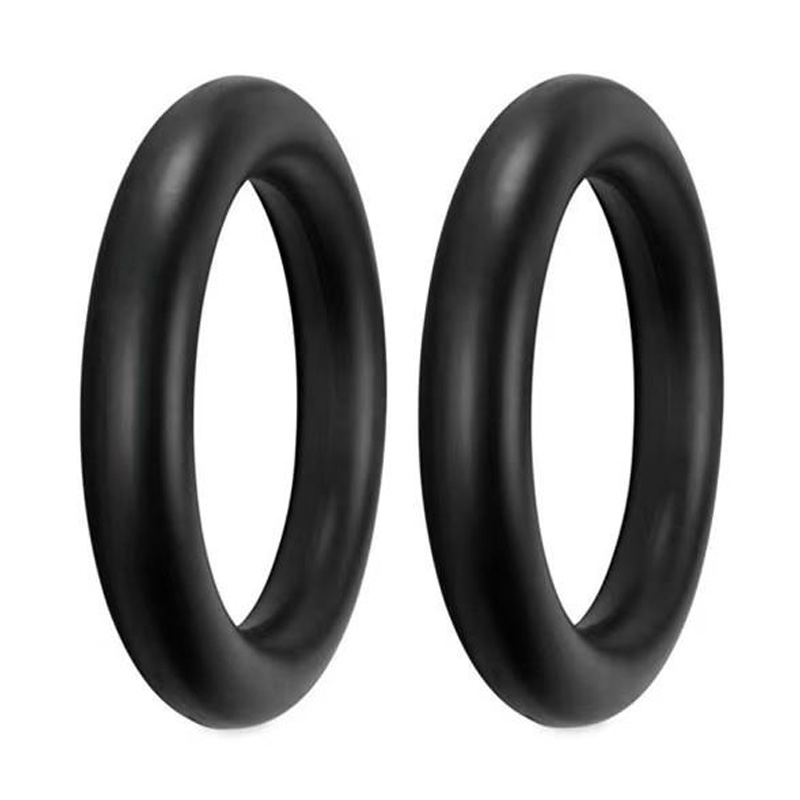
Motorcycle rear tires come in two shapes on the full-size market, and the 110/90-19 mousse insert belongs to the wider of them. The 110/90-19 is a 110 mm section width on a 90% aspect ratio, giving a 99 mm sidewall and an overall diameter of roughly 681 mm on a 19 inch rim — a tire that puts more rubber on the ground than anything else in the rear range and is correspondingly heavier at 1.2–1.5 kg.
That extra width is not decoration. The rear wheel is the only wheel that transmits power to the ground, so the amount of rubber it puts down is the amount of grip available to accelerate the bike, and a 110 mm patch finds traction in places a 100 mm patch does not. It is the reason this size is fitted to the heaviest full-size machines and to the ones that spend their weekends on soft, slow ground rather than on a prepared track.
Motobike Más builds the 110/90-19 Motocross Mousse Insert (SKU MMO-003) in its own Tianjin factory, in three density grades — Soft, Medium and Standard — with an effective pressure equivalent of 8–12 psi and a published unit weight of approximately 1.2–1.5 kg. The insert is a closed-cell nitrile rubber tube that carries the structural load the compressed air would otherwise carry, so a rock, a root or a thorn cannot deflate the rear wheel, and it removes up to 40% of the rotating mass a tube plus a heavy-duty rim lock would put on the back of the bike. The tire around it is still inflated with air in the normal way: the mousse provides the structure, and the air still sets the profile, the grip and the rolling resistance.
Son güncelleme tarihi: 19 Kasım 2026. Veri kaynakları: the published Motobike Más specifications for MMO-003, the factory’s published fitment, density, pressure and lifespan tables, and the factory’s size and certification documentation. Figures shown as “≈” are calculated from the published tyre size designations rather than measured by the factory.
A 110/90-19 is a 110 mm section width on a 90% aspect ratio, which works out at a 99 mm sidewall and an overall diameter of roughly 681 mm on a 19 inch rim. It is the wide-profile rear, and the width is the whole point of it: 110 mm of rubber on the ground against the 100 mm of the 100/90-19, on the same rim diameter, with the same aspect ratio.
More rubber on the rear means more traction and more stability, and the rear is the wheel that needs both. The rear carries drive torque for the whole of the event and it is the wheel that breaks traction when the rider asks for acceleration out of a corner, so the extra 10 mm of section width is what lets a heavier bike or a deeper surface find grip rather than spin the rear away. The cost is rotation: the wider carcass is heavier, and the published unit weight for this insert is approximately 1.2–1.5 kg against 1.1–1.4 kg for the narrower 100/90-19.
What the insert does not do is change the size of the tire. A 110/90-19 insert is cut for a 110 mm section width on a 90% aspect ratio on a 19 inch rim, and it will not seat correctly in a 100/90-19 or a 120/90-18 tire. The full size-by-size compatibility picture is on the mousse ek parçası boyut kılavuzu, and the fitting method is in the mousse ek parça kurulum kılavuzu.
Three numbers carry the whole size, and every spec sheet for this insert follows from them: 110 mm of section width, a 90% aspect ratio, and a 19 inch rim diameter. The section width sets how much rubber reaches the ground, the aspect ratio sets how tall the sidewall stands — at 90% of 110 mm that is a 99 mm sidewall — and the rim diameter sets the bead the whole thing is built around.
Add those together and the tire’s overall diameter works out at roughly 681 mm, which is 18 mm more than the narrower 100/90-19 rear on the same rim and about 14 mm less than the 90/90-21 front most of these machines run. A full-size bike on this rear therefore sits with a front slightly taller than its rear, close enough that the gearing and the speedometer are unaffected and the handling difference comes from the width of each tire rather than from their diameters.
| Veri noktası | Değer | Durum |
|---|---|---|
| Boyut belirtimi | 110/90-19 — 110 mm section, 90% aspect ratio, 19 in rim | Yayınlandı |
| SKU | MMO-003 | Yayınlandı |
| Yoğunluk sınıfları | Yumuşak / Orta / Standart | Yayınlandı |
| Birim ağırlık | Yaklaşık 1,2–1,5 kg | Yayınlandı |
| Etkin basınç eşdeğeri | Sınıfına bağlı olarak 8–12 psi | Yayınlandı |
| Kullanım ömrü | 200–500 yarış mili | Yayınlandı |
| Dönen kütlenin azaltılması | Bir tüp ve bir ağır hizmet tipi jant kilidine karşı 40%'ye kadar | Yayınlandı |
| Menşe ülke | Tianjin, Çin | Yayınlandı |
| Parti boyut toleransı | Üretim partisi başına | Talep üzerine teyit edilir |
| Toplu işleme iç yoğunluk toleransı | Üretim partisi başına | Talep üzerine teyit edilir |
| Mevcut sınıf isimlendirmeleri ve sürücü ağırlık aralıkları | SKU başına | Talep üzerine teyit edilir |
| Boyut | Bölüm genişliği | En-boy oranı | Yanak yüksekliği | Jant çapı | Toplam çap |
|---|---|---|---|---|---|
| 110/90-19 — this size | 110 mm | 90% | ≈ 99 mm | 19 inç | ≈ 681 mm |
| 100/90-19 — narrow rear | 100 mm | 90% | ≈ 90 mm | 19 inç | ≈ 663 mm |
| 120/90-18 — ralli arka lastiği | 120 mm | 90% | ≈ 108 mm | 18 inç | ≈ 673 mm |
| 140/80-18 — heavy-duty rear | 140 mm | 80% | ≈ 112 mm | 18 inç | ≈ 681 mm |
| 90/90-21 — typical front | 90 mm | 90% | ≈ 81 mm | 21 in | ≈ 695 mm |
| 80/100-21 — MX front | 80 mm | 100% | ≈ 80 mm | 21 in | ≈ 693 mm |
“≈” değerleri, yayınlanmış boyut tanımlarından hesaplanır — yanak yüksekliği, kesit genişliğinin en-boy oranıyla çarpımıdır; toplam çap ise jant çapı artı yanak yüksekliğinin iki katıdır. Bu değerler, boyutları birbirleriyle karşılaştırmak için kullanışlıdır ve fabrika tarafından ölçülmüş rakamlar değildir; fabrika, talep üzerine ölçülen boyutları teyit eder. Yayınlanmış her boyut için tam çap tablosu mousse ek parçası boyut kılavuzu.
This size is published in three named density grades — Soft, Medium and Standard — and each grade comes with a published effective pressure equivalent and a published rider-weight band. That matters on the rear wheel, because the rear is where the rider’s weight is doing the most work: too firm and the tire bridges over the surface instead of settling onto it, so the rear spins up instead of driving; too soft and the insert gives up early under drive torque, and the traction that was there at the start of the race is gone by the second half of it.
| Yoğunluk derecesi | Etkin basınç eşdeğeri | Yayınlanmış arazi kılavuzu | Yayınlanan sürücü ağırlık aralığı |
|---|---|---|---|
| Yumuşak | 8–10 psi | Mud, sand, loam and wet conditions | 75 kg altı |
| Orta | 9–11 psi | Mixed terrain, all-around use | 75–90 kg |
| Standart | 10–12 psi | Rocky, hard-packed, desert and high-speed | 90 kg üzeri |
The published bands are the same as the other full-size rears in the range: under 75 kg on the Soft grade, 75–90 kg on Medium, over 90 kg on Standard, with the published terrain guidance following the rider weight rather than the other way round — Soft for mud, sand, loam and wet conditions, Medium for mixed terrain and all-around use, Standard for rocky, hard-packed, desert and high-speed riding.
What makes the 110/90-19 worth stocking specifically is that it is the rear size on the heaviest of the full-size machines. The published size-selection guidance puts this size at over 75 kg recommended, against under 85 kg ideal for the narrower 100/90-19, which is a different dimension from the grade bands above — the bands choose the grade, the size guidance chooses the size. A rider over 90 kg on this size is on the Standard grade and on the wide rear, and a rider under 75 kg is on the Soft grade and would be better served by the narrow rear. The full comparison is in the section below, and the naming convention used across the whole range is set out on the mousse ek parçası boyut kılavuzu.
Two 19 inch rear sizes cover almost the entire full-size off-road market, and choosing between them is the most common rear specification decision a distributor makes. The 110/90-19 and the 100/90-19 are not two versions of the same part — each size has its own insert, cut to its own tire, and each needs its own rear mousse. Between them they cover nearly every full-size machine sold, which is why most distributors stock both.
| Boyut | SKU | Position | Typical use | Published unit weight |
|---|---|---|---|---|
| 110/90-19 | MMO-003 | Rear | Standard full-size motocross and enduro rear; the wide-profile rear | 1.2–1.5 kg |
| 100/90-19 | MMO-004 | Rear | Narrower full-size rear for lighter riders and quicker steering | 1.1–1.4 kg |
| 120/90-18 | MMO-001 | Rear | Rally, hard enduro and desert rear on an 18 inch rim | Available on request |
| 140/80-18 | MMO-002 | Rear | Heavy-duty adventure, rally and expedition rear | Available on request |
| 90/100-16 | MMO-009 | Rear | Youth motocross, mini dirt bike and pit bike rear on a 16 inch rim | 0.7–0.9 kg |
The published size-selection guidance in that table is the line to work from, and it is worth reading carefully because the two rider-weight figures overlap. The 100/90-19 is published as under 85 kg ideal and the 110/90-19 as over 75 kg recommended, so the band between roughly 75 and 85 kg is the zone where a rider can go either way — and the tie-breaker is the bike and the terrain, not the rider alone. A 250cc on a tight track and a 450 on a fast, open surface both fall in that band, and they do not want the same rear.
The other line that decides it is the weight. At approximately 1.2–1.5 kg this insert is 100 to 200 g heavier than the 100/90-19, and that mass sits at the very end of the bike where it is felt in every direction change. The wider rear buys traction and straight-line stability with that mass, which is the correct trade for a heavy bike, a big rider or a deep surface, and the wrong trade for a light bike on a fast, flowing track.
For a distributor the practical consequence is that the two sizes serve genuinely different customers rather than being interchangeable stock. The 110/90-19 moves into enduro, cross-country and heavier-rider accounts, and it is the size that pairs with the wide front on an adventure platform. The 100/90-19 moves into motocross and lighter-rider accounts. Both run on the same production line with the same tooling, so there is no operational reason to carry one and not the other — the reason to carry both is that a customer who arrives with a bike on a 110/90-19 rear cannot be served with a 100/90-19 insert.
Buyers who need only one of the two should check the rear tire size on the machine before ordering. The size is printed on the sidewall, and the mousse ek parçası boyut kılavuzu lists every size the factory currently publishes. For the wider wholesale picture, see the toptan alım rehberi.
| Sınıf | Modeller |
|---|---|
| 250cc motocross | Honda CRF250R, Yamaha YZ250F, KTM 250 SX-F, Husqvarna FC 250, Kawasaki KX250, Suzuki RM-Z250, GasGas MC 250F |
| 450cc motocross | Honda CRF450R, Yamaha YZ450F, KTM 450 SX-F, Husqvarna FC 450, Kawasaki KX450, Suzuki RM-Z450 |
| Enduro / cross-country | KTM 300 XC-W, KTM 350 EXC-F, KTM 500 EXC-F, Husqvarna TE 300, FE 350, FE 501, Beta RR 300 / RR 350 / RR 430 / RR 480, Sherco SE 300 / SE 500, GasGas EC 250 / EC 300 |
This size’s strength is breadth. The 110/90-19 is the shared rear across the full-size motocross and enduro platforms, which means one SKU covers an unusually wide machine population, and it is the reason distributors carry it as the default rear rather than as a specialist item.
One group is worth pulling out because it changes the buying decision. The enduro and cross-country platforms listed in the table — the KTM 300 XC-W, 350 EXC-F and 500 EXC-F, the Husqvarna TE 300, FE 350 and FE 501, the Beta RR range, the Sherco SE machines and the GasGas EC 250 and EC 300 — are the ones that pair a 110/90-19 rear with a 21 inch front. The enduro-specific decisions on those machines are about the front, and the rear stays the same as the motocross setup.
That is also where the wide rear earns its place in a way it does not on a motocross bike. Enduro stages run longer, on softer ground, with more load carried over the rear through technical sections, and a rear that spins up in a muddy corner costs far more on a stage than it does in a two-lap heat. The hard enduro versus desert racing comparison sets out that difference in terrain terms, and the mousse selection guide for enduro riding covers how the size fits into a wider enduro setup.
The argument for mousse on a full-size motocross bike is not theoretical. These are the practical differences a race team or a dealer’s customer feels.
| Faktör | Mousse ek parçası | İç lastik |
|---|---|---|
| Düz önleme | Tamamen kapalı — hava odası olmadığı için hava kaybı olmaz | Vulnerable to pinch flats and punctures |
| Bakım | Kurulduktan sonra hiçbiri | Her sürüşten önce lastik basıncını kontrol edin |
| Dönen kütle | Alt kısım — borusuz ve daha hafif jant kilidi | Daha yüksek |
| Traction | Consistent through the race | Changes with pressure and temperature |
| Kurulum | More difficult | Daha kolay |
| Reusability | Transfer to a new tire if still serviceable | Replaced at every tire change |
| Terrain adaptability | Fixed by the density grade chosen | Adjustable through pressure |
Two lines in that table carry the weight of the argument on a rear wheel.
The first is traction consistency. A tube’s pressure drifts with temperature through a race, and a rear that changes its footprint as the engine heats up is a rear that changes its traction. The published comparison notes that a mousse is consistent throughout the race while a tube changes with pressure and temperature, and on the rear that consistency is what lets a rider hold a line on the throttle instead of correcting for it.
The second is terrain adaptability. A tube can be run at a different pressure for a different track, which sounds like an advantage until it is set against the fact that the same pressure does not work in the mud and in the desert. The mousse’s terrain behaviour is fixed by the density grade chosen, so the choice is made once at the order and then it holds for the whole season.
The general comparison across sizes, including the front-wheel safety cases and the cost side of the argument, is in mousse ek parçası ile iç lastik karşılaştırması, ve alternatif kapalı hücreli sistemler şu şekilde karşılaştırılmaktadır: Mousse ile Tubliss sistemi karşılaştırması.
The rear wheel is the only wheel that transmits power to the ground, and that single fact explains almost every difference between this size and a front insert.
Drive torque is the load that matters. The engine pushes against the rear contact patch through the whole of the event, and the friction generated there is what moves the bike. Every unit of torque has to be reacted by the rear tire, and the amount of grip available to react it is what limits acceleration. This is why the rear is the wheel where 10 mm of extra section width is worth the weight it costs: a wider patch has more rubber in contact with the surface, and more rubber is more grip.
The rear generates more heat than the front. Drive torque is converted into heat in the carcass at the rear, and heat is what ages closed-cell foam fastest. This is the reason the published comparison puts the front’s heat generation as lower and the rear’s as higher, and it is why the two wheels do not wear at the same rate even when they are the same size. A front insert generally outlasts a rear insert on the same machine.
Which is why the rear is usually the one that gets replaced first. On a full-size motocross bike running a 110/90-19 rear, the rear insert is normally the first part to reach the end of its life. That has a practical consequence for a race team budgeting a season, and for a distributor whose customer keeps coming back for rear inserts more often than front ones. The published lifespan table below gives the expected life by use case, and the mousse ek parçası kullanım ömrü sayfası covers the replacement criteria in full.
Köpük dolgu parçası üzerinde asla petrol bazlı yağlayıcılar kullanmayın. Petroleum products degrade nitrile rubber, and a degraded insert is a liability, not a saving. Use water-based mousse lubricant only, on both the insert and the bead seat of the rim.
Genel işlem sırası — lastik kenarının yerleştirilmesi için hazırlık, yağlayıcı sürülmesi, ilk kenar, ikinci kenar, son yerleştirme ve profili sabitleyen basınç döngüsü — şu belgede belirtilmiştir: mousse ek parça kurulum kılavuzu ve bu boyuta da aynen uygulanır.
Check the rim width before the tire goes on. A 110 mm section width on a 19 inch rim is the widest rear in the range, and the tire’s fitment marking needs to be checked against the rim width before the tire is mounted. A forced insert sits off-centre, which shows up as a rear that feels vague on corner exit and is the most common cause of a 110/90-19 that “never quite felt right” after fitting.
Inspect the insert at every refit. A motocross wheel is rebuilt between races and often more than once in a race day, and every rebuild levers a bead back over a rim. That is the moment an insert is most likely to be pinched at the bead and to take a compression set that cannot be seen from the outside. Check the insert at every refit rather than assuming that a tire which was fine at the start of the race is still fine at the finish, and treat any insert that has been levered over a bead as needing an inspection before it goes back in.
Motobike Más publishes 200–500 racing miles as the typical service life for this size. On a full-size motocross or enduro bike, life is usually quoted in racing miles rather than hours, because an insert is consumed by track time rather than distance covered on the road — and the hours-based figures quoted elsewhere in the category are a different measure of the same thing, not a competing number.
| Item | Detay |
|---|---|
| Typical service life | 200–500 yarış mili |
| Replace when | It feels noticeably softer or spongy, there are visible tears or chunks missing, it deforms, or it is running excessively hot |
| Reusability | A serviceable insert can be transferred to a new tire of the same size |
| Storage | Cool, dry place away from direct sunlight, not compressed or folded, away from ozone sources such as electric motors and welding equipment |
| Shelf life in sealed packaging | 3–5 years |
The published comparison for this size also makes the point that the rear wears faster than the front on the same machine, and it is worth planning around: a rider who replaces one insert per season on the front will typically get through one on the rear as well or sooner, because the rear is doing the work.
Actual life depends on terrain, rider weight, the grade chosen and how often the wheel is refitted. The general replacement and storage criteria that apply across every size are covered in mousse insert lifespan ve how long a motorcycle mousse lasts.
Motobike Más produces mousse in its own Tianjin facility in the Nankai District, covering 50,000 m² of production floor, warehousing and R&D space, and the factory walkthrough ürün yelpazesinin ardında yer alan üretim hatlarını, depolama sistemini ve kalite sistemlerini göstermektedir.
What makes this size awkward to make well is the width. A 110 mm section is the widest rear the line cuts, which means more foam to fill, a longer mould and a larger expansion volume during the cure — and a batch that runs slightly wide or slightly narrow is a batch that will not seat cleanly on a 19 inch bead seat. Dimensional inspection is therefore the check that carries the most weight on this SKU, and it runs alongside the density, compression recovery, heat resistance and structural integrity verification that every insert in the range passes before packing.
The failure mode that matters commercially is worth naming: a dimensional drift on this size reaches the customer not as a reject but as a rear wheel that feels vague on corner exit, because the insert is sitting off-centre. That is why the factory holds the profile across production batches rather than running to the nearest convenient measurement, and it is why the full inspection regime is described in the kalite kontrol süreci adım adım kılavuzu.
The 110/90-19 is supplied as a made-to-order factory line rather than from finished-goods stock. The terms that apply across the range — the minimum set per order and confirmed on request, standard OEM production at 15–30 days depending on quantity and customization, pre-production samples for evaluation, and shipping by sea on FOB Tianjin terms, by air freight or DDP — are published together on the mousse ek parçası boyut kılavuzu, o toptan alım rehberi ve OEM ve ODM üretimi sayfalar.
On this particular size the ordering decision is usually made once and made for a long time, because the 110/90-19 is the highest-volume rear on the line and the one that stays fitted to a machine for years. A dealer who commits to it is stocking a size that will come back through the same doors every season, which is why most distributors treat it as the anchor of a rear range rather than as one option among several.
That makes it a good candidate for a private-label programme. Custom branding, packaging and colours are available on the OEM and ODM route, along with custom density formulations, and a rear that a customer re-orders every season is the kind of SKU where the label and the packaging are worth doing properly. The two full-size rears the factory publishes run on one line with one set of tooling, so the 110/90-19 and the 100/90-19 can travel on a single purchase order, as can the 120/90-18 ve 140/80-18.
It is a rear size, and specifically the wide-profile rear. The 110/90-19 appears on the full-size motocross and enduro platforms as the standard rear fitment, and the published size-selection guidance puts it at over 75 kg recommended, which is why it turns up on the heavier machines in the range rather than the light ones. The front wheel on those same bikes normally runs a 21 inch tire such as the 90/90-21 or the 80/100-21.
The grade follows the rider weight, and the published bands on this size are the same as the other full-size rears: Soft for riders under 75 kg on mud, sand, loam and wet conditions at 8 to 10 psi, Medium for 75 to 90 kg on mixed terrain and all-around use at 9 to 11 psi, and Standard for over 90 kg on rocky, hard-packed, desert and high-speed riding at 10 to 12 psi. On the wide rear the grade matters more than on a narrow one, because the extra 10 mm of rubber is already finding grip and the foam’s job is to shape the tire over rough ground rather than to dig into the surface.
The published effective pressure equivalent for this size is 8 to 12 psi depending on the grade selected, against the 12 to 18 psi typically used for a tube setup on the same off-road tire. Which band a rider runs comes from the grade: 8 to 10 psi on the Soft grade for riders under 75 kg, 9 to 11 psi on the Medium grade for 75 to 90 kg, and 10 to 12 psi on the Standard grade for riders over 90 kg. The grade and the tire pressure are separate settings, and the tire pressure is set from the bike’s own guidance rather than from the bar figure.
Ten millimetres of section width on the same 19 inch rim, and everything that follows from it. The 110/90-19 gives more traction and more straight-line stability and is the published choice for heavy bikes, high-speed riding and deep loam, with size-selection guidance at over 75 kg recommended. The 100/90-19 is narrower, quicker to steer and published as under 85 kg ideal. The wide rear also carries roughly 100 to 200 g more, at 1.2 to 1.5 kg against 1.1 to 1.4 kg, and sits about 18 mm larger in overall diameter, which changes gearing when a bike moves between them.
Motobike Mas publishes 200 to 500 racing miles as the typical service life for the 110/90-19. The rear is the wheel that wears out first on a full-size bike, because it carries the drive torque for the whole event and generates more heat as a result, and heat is what ages closed-cell foam fastest. The hours-based figures quoted elsewhere in the category measure the same thing rather than being a competing number. Actual life depends on terrain, rider weight, the grade chosen and how often the wheel is refitted.
No, and the reason is physical rather than a matter of tolerance. The insert is cut to a 110 mm section width on a 90% aspect ratio, and a 100/90-19 tire is a different carcass with a different profile and a different internal volume. A 110/90-19 insert will not sit correctly in it, and forcing it damages the bead and the foam. The same rule works in reverse: a 100/90-19 insert is not a substitute for the wide rear either. Match the insert to the designation printed on the tire.
Yes, and on this size the answer is closer than on any other in the range. The published unit weight for the insert is 1.2 to 1.5 kg against roughly 400 to 600 g for an inner tube of the same size, so this is the heaviest insert the factory publishes. What tips the balance is what the mousse replaces: the rotating mass reduction against a tube plus a heavy-duty rim lock is up to 40% on this size as on every other, and on the wide rear that saving is measured against a rim lock that is heavier to begin with.
Water-based mousse lubricant only, on both the insert and the bead seat of the rim, and never a petroleum-based product — petroleum degrades nitrile rubber. Two points are specific to the wide rear. Check the rim width against the tire fitment marking before mounting, because a 110 mm section is the widest rear on the line and a forced insert sits off-centre in a way the rider feels as a vague rear on corner exit. And inspect the insert at every rebuild rather than trusting it from the last session, because a bead levered over a rim is the most common way an insert picks up a compression set.
The minimum is set per order and confirmed by the factory on request, because the range is made to order rather than pulled from finished-goods stock. Standard OEM production typically runs 15 to 30 days depending on quantity and customization, pre-production samples are available for evaluation, and shipping is by sea on FOB Tianjin terms, by air freight or DDP. This is the highest-volume rear on the line, so it is the size most often run under a private label with custom branding, packaging and colours.
Motobike Mas manufactures tires and mousse inserts under ISO 9001:2015 quality management, to DOT and ECE production standards. Every insert passes density, compression recovery, heat resistance, dimensional and structural integrity verification before packing, and on the 110/90-19 the dimensional check carries particular weight, because a wide carcass that varies across a batch reaches the customer as a rear that feels vague rather than as a reject. The certification documentation is on the motorcycle tire certifications page and the inspection regime in the quality control walkthrough.
The 110/90-19 Motocross Mousse Insert (SKU MMO-003) is produced on the Motobike Más line in Tianjin and supplied to importers, distributors, dealers, race teams and aftermarket brands worldwide. It is available in Soft, Medium and Standard densities, with a published unit weight of approximately 1.2–1.5 kg and an effective pressure equivalent of 8–12 psi depending on the grade selected.
Ask for the current minimum, the density mix and the lead time on the 110/90-19, or take a set of pre-production samples before placing a bulk order. This is the highest-volume rear on the line and the one most accounts come back to every season, so it suits a private-label programme as well as a stock-and-reorder model — custom branding, packaging, colours and density formulations are all available on the OEM route.
Şu 110/90-19 product page tam teknik özellikleri içerir ve fabrikanın iletişim sayfası takes specification requests directly. Importers who want the whole rear range on one order should read the mousse ek parçası boyut kılavuzu, which also explains the grade naming conventions used across the different sizes, and the ISO 9001, DOT ve ECE sertifikasyon belgeleri covers the file a distributor needs on file.
120/90-18 Mousse Insert | Enduro & Rally Fitment Guide şöyle diyor:
[…] Yes — MMO-003 · size & pressure guide […]
100/90-19 Mousse Insert: Narrower Rear Profile Fitment Guide - Motobike Más şöyle diyor:
[…] improper fitment, reduced performance and a safety risk. The wider rear option is covered in the 110/90-19 motocross mousse insert guide and on the 110/90-19 product page, and the full size reference including the front sizes is in […]
90/90-21 Mousse Insert | Off-Road Enduro Front Fitment Guide şöyle diyor:
[…] with the 110/90-19 rear, a distributor can build a matched front-and-rear pair from two SKUs. The 110/90-19 motocross mousse insert guide covers the rear half of that pair, the 100/90-19 narrower rear profile guide covers the […]
70/100-19 Mousse Insert: Youth MX and Pit Bike Front Fitment - Motobike Más şöyle diyor:
[…] high performance mousse cover the full-size rear fitments that the same riders move up to, and the 110/90-19 guide and the 100/90-19 narrower rear profile guide explain when to move a customer from one rear width […]