
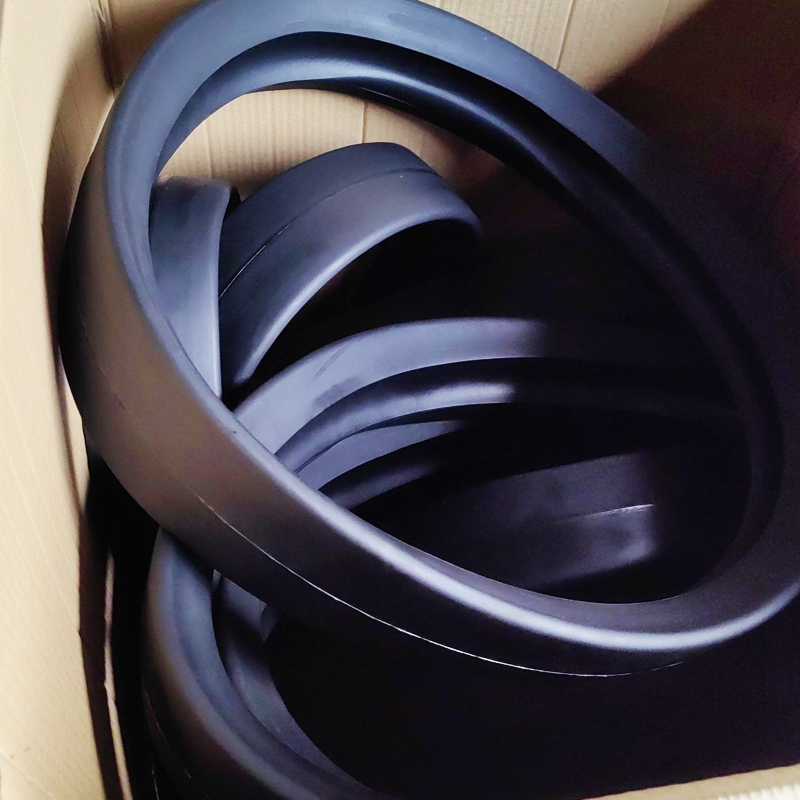
A mousse insert is a solid, closed-cell foam tube that replaces the air-filled inner tube inside a motorcycle tire. Made from nitrogen-infused nitrile rubber foam, it sits between the tire carcass and the rim, carries the load that compressed air would normally carry, and keeps the tire seated on the rim even after a puncture. Motobike Más builds these inserts in its own Tianjin factory, and this guide explains what they are, how they work, where they belong, and where they cost you more than they give you.
Most explanations of mousse stop at the marketing line: no flats, better grip, ready for anything. Parts of that line are wrong, and the wrong parts cost riders money. This guide covers the construction, the failure modes, the trade-offs, and the situations where a regular inner tube is the smarter buy.
| Question | Short answer |
|---|---|
| What is a mousse insert? | A solid foam tube that takes the place of the inner tube. The tire around it still holds air. |
| What is it made of? | Closed-cell nitrile rubber foam with nitrogen in the cells. Density runs from 140 to 230 kg/m3 depending on grade. |
| Does the tire still need air pressure? | Yes. The mousse carries the load; the air in the tire sets the profile, grip and rolling resistance. |
| How heavy is one? | 0.7 to 1.5 kg by size, against 400 to 600 g for an inner tube of the same size. |
| How does it fail? | Gradual compression set accounts for 70 to 80 percent of failures. Heat ends a mousse fastest. |
| When should you not use one? | Long paved distances, street and touring duty, weight-sensitive bikes, and riders who want a cheap consumable. |
The name comes from the French word for foam. The industry also calls these products foam tubes, foam inserts, solid inner tubes, or foam tire liners. All four names describe the same object: a hollow cylinder of foam with an open bore that fits inside a tubeless tire. The best-known names in the category are Michelin Bib Mousse, Nitro Mousse and Tusk, and each of them solves the same problem in a slightly different way.
Inside that foam are millions of microscopic closed cells. Each cell holds nitrogen, and the cell walls, not the gas, carry the load. When you inflate a mousseless tire, compressed air supports the bike through the tire carcass. When you fit a mousse, the tire’s air pressure drops to a lower working value and the foam takes over the structural role. That is why mousse tires run at visibly lower pressures than tube tires, and why the industry quotes mousse hardness as a pressure equivalent rather than a durometer rating.
The closed cell structure is what separates a mousse from kitchen sponge. Closed cells do not absorb water, they hold shape under repeated compression, and they recover most of their original height after each load cycle. That recovery matters more than anything else, because every wheel revolution compresses the foam and lets it rebound. A foam that does not recover is finished.
Three measurable parameters separate a good mousse from a cheap one. Densità (kg/m3) decides how stiff the foam feels and how much it weighs. Compression set (percent after 24 hours) decides how fast it gives up. Tensile strength (kPa) decides whether it survives being stretched over a sharp bead. Our standard formulation runs 140 to 230 kg/m3 density, under 15 percent compression set after 24 hours, and 80 to 120 kPa tensile. Our premium formulation tightens every one of those figures: 150 to 230 kg/m3, under 8 percent compression set, and 120 to 180 kPa tensile, with a density tolerance of plus or minus 1.5 to 2 percent across a batch instead of plus or minus 5 percent.
| Grade | Pressure equivalent | Best for | Trade-off |
|---|---|---|---|
| Ultra morbido | 0.3 bar | Extreme enduro, wet rock, technical crawling | Wears fastest of the four |
| Morbido | 0.5 bar | Sentieri nel bosco, single track, terreno misto dal punto di vista tecnico | Moderate heat tolerance |
| Medio | 0.8 bar | Deserts, grasslands, all-around enduro | Our highest-volume grade |
| Duro | 1.1 bar | Rally, Baja-style racing, sustained speed | Firmest feel, longest life |
Our production density range spans 140 to 230 kg/m3 across the four grades, and the harder the grade the higher the density. Each product page lists the hardness options it is supplied in, from ultra soft to heavy duty.
If you want the density matched to a specific riding style, our la migliore mousse per moto da enduro guide walks through the selection logic grade by grade, including the hardness we recommend for each race type and the measured hours of life behind each recommendation.
Two facts get mixed up constantly, and almost every forum answer about mousse gets one of them wrong. The first: a mousse does not remove the air from the tire. The tire is still an air tire. Its carcass is still inflated, the rim still has to hold the tire bead on a designed pressure range, and the pressure in the tire still decides how the tread contacts the ground.
The second: the foam does not just sit there. It becomes the structural support for the tire. The mousse carries the vertical load, takes the cornering forces, and absorbs the impact energy that would otherwise come out of the sidewall of a tube tire.
A pinch flat happens when a tube is compressed hard enough between rim and rock that it splits. A mousse cannot split that way. The foam compresses instead of cracking, repeatedly, without losing shape. The same logic removes snake bites, the double puncture where a tube is pinched against the rim and then pierced. With no air inside the foam to lose, the tire does not drop pressure when the carcass is cut and the wheel stays on the rim.
A mousse solves rim-strike and pinch-flat failures. It does not repair a cut sidewall, and a deep cut through the carcass still needs a new tire. A direct rim strike at speed can damage the rim, and the foam offers no protection there. Chemical damage is a third blind spot: petroleum-based lubricant dissolves and softens the foam on contact, which is why water-based mousse lubricant is the only acceptable option during installation.
Mousse hardness is quoted as an equivalent pressure, describing how the foam feels under load compared with the same air pressure in a tube. It is a reference for consistency across densities and sizes, not a tire pressure setting. Actual tire pressure still has to stay inside the range the tire and rim are rated for.
A mousse lives or dies on hours, not on distance or the calendar. The insert that survives 150 hours of trail riding can be destroyed in 30 hours of desert racing. These are our published figures by use case, assuming correct density selection and installation.
| Caso d'uso | Terreno | Durata prevista | Pneumatici per mousse |
|---|---|---|---|
| Motocross (professionistico) | Piste battute, neve compatta | 30 to 60 hours | Da 1 a 2 pneumatici |
| Motocross (amatoriale) | Condizioni del tracciato variabili | 50 to 80 hours | da 2 a 3 pneumatici |
| Enduro (professionisti) | Single track tecnico, rocce, radici | 40 to 70 hours | Da 1 a 2 pneumatici |
| Enduro (livello intermedio) | Percorso misto | 60 to 100 hours | da 2 a 3 pneumatici |
| Enduro estremo | Rocce scoscese, tronchi, salite ripide | 25 to 50 hours | 1 pneumatico |
| Gare nel deserto e rally | Terreni accidentati ad alta velocità | 30 to 60 hours | Da 1 a 2 pneumatici |
| Escursioni a cavallo (informali) | Sentieri e strade antincendio ben tenuti | 80 to 150 hours | Da 3 a 5 pneumatici |
| Flotta a noleggio | Condizioni variabili | 60 to 120 hours | Da 2 a 4 pneumatici |
Our Guida alla durata dell'inserto per mousse breaks down the physics behind these numbers, including why hard enduro is harsher on a mousse than a desert race despite similar speeds.
Mousse is a specialist tool. Used outside its design envelope it costs money, weight or comfort, and in a few cases safety. These are the situations where a regular inner tube is the better buy.
A mousse has no air flowing through it, so it cannot shed heat the way a tube does. Our lab data puts internal mousse temperature at 90 to 120 C during high-speed desert riding and above 130 C in the failure range. On a motorway that heat builds with the wheel barely rotating, and the tire sits at higher working pressures. Standard foam is rated for 80 to 100 C sustained, so long fast paved sections sit outside the design envelope.
Street tires are engineered around air pressure doing the structural work. A mousse inside a street tire gives up the ride comfort a compliant air column provides, adds weight, and replaces a consumable that costs a few dollars with one that costs far more. On a commuter bike, the financial case does not exist.
A mousse weighs more than the tube it replaces. In our range, a 90/100-16 kids bike insert runs 0.7 to 0.9 kg, a 90/100-21 rally insert 1.1 to 1.3 kg, and a 110/90-19 motocross insert 1.2 to 1.5 kg. An inner tube of the same size weighs 400 to 600 g. That difference sits at the wheel, so it is unsprung mass, and it shows on small-displacement bikes, light scooters and electric platforms where every kilogram of wheel-end mass changes the handling.
A thorn on a maintained trail is a two-minute fix with a spare tube and a pair of levers. The same puncture with a mousse usually means buying a replacement insert. On low-risk terrain ridden a few times a season, a tube is cheaper and faster to sort out.
Fleet managers optimising for cost per hour served will find tubes cheaper per replacement and faster to swap between bikes. Mousse wins on downtime for the rider, not on invoice price for the operator.
Foam ages faster than rubber. Store mousse below 30 C and under 70 percent relative humidity, flat or standing on end, and it keeps its properties for three to five years from the manufacturing date. Dealers in hot climates with seasonal cycles should watch that window and rotate stock on a first-in, first-out basis.
Modern tubeless setups with sealant handle small punctures well and keep the wheel light. Adding a mousse on top of that buys extra weight for protection you may not need on the terrain you actually ride.
| System | How it works | Peso | Flat protection | Best for |
|---|---|---|---|---|
| Mousse insert | Solid foam replaces the tube | Heaviest | Best. No air to lose. | Technical off-road, race and enduro |
| Camera d'aria | Air supports the load | Lightest | Low. Pinch flats and snake bites. | General riding, street, low-risk trail |
| Tubliss | Tubeless with a self-sealing liner | Middle | Alto | Dual sport and adventure riders who keep street tires |
| Tubeless with sealant | Air plus liquid sealant | Lightest | Medium. Seals small holes only. | Trail, gravel, dual sport |
The two comparisons riders ask us about most often have their own pages: mousse insert vs the Tubliss system e mousse insert vs inner tube, both with the cost analysis included.
Mousse failure is predictable. That predictability is the main advantage over a tube, and it also means you can plan for it.
Every wheel revolution compresses the foam and lets it rebound. Over thousands of cycles, cell walls rupture and the foam loses elastic recovery. This is compression set, and it accounts for 70 to 80 percent of mousse failures under normal use. The foam softens, the tire deforms more, and grip drops before anything visibly breaks. Our replacement indicator is simple: if the installed mousse lets the tire deform more than 15 to 20 percent under normal load, it is done.
Heat breaks down the foam chemistry. Above 60 C the structure starts to deteriorate and compression set accelerates. Our rally formulation is rated for 110 C sustained operation with a 140 C peak, against 80 to 100 C for standard foam. The fastest heat damage comes from sustained speeds above 80 km/h on rough terrain, low tire pressure in fast conditions, ambient temperatures above 35 C and long high-rpm stretches on hard surfaces.
Petroleum-based lubricants dissolve or soften the foam. Fuel and oil spills cause local softening that does not come back. Ozone and ultraviolet exposure degrade the surface during storage. Use only water-based mousse lubricant, and clean spills with mild soap and water.
Temperature figures in this industry are usually copied from a catalogue. Ours come from the R and D center at our Tianjin factory, with the method published so a buyer can compare it against any other supplier.
| Condizione | Speed range | Internal temperature | Risk |
|---|---|---|---|
| Extreme enduro, crawling | 5 to 20 km/h | 50 to 70 C | Basso |
| Enduro su single track | 20 to 50 km/h | 60 to 85 C | Low to moderate |
| Gare nel deserto e rally | 80 to 120+ km/h | 90 to 120 C | Alto |
| Overheated, failure imminent | Qualsiasi | 130 C and above | Critico |
K-type thermocouples sit at three positions inside each test insert, at the centre, the sidewall contact zone and the tread contact zone, so we capture the internal gradient rather than a single reading. A purpose-built single-wheel dynamometer simulates sustained speeds from 5 to 140 km/h across adjustable loads. Readings are logged every 10 seconds over sessions of at least four hours, with five samples per density formulation and outlier removal per ASTM E178, at 22 C ambient with airflow calibrated to real riding conditions. The methods follow ASTM D1056 for flexible cellular materials and ISO 5893 for rubber testing.
Three decisions stand between you and the right insert.
An undersized mousse moves inside the tire. A moving mousse generates friction and heat, wears unevenly and eventually tears. Our Guida completa alle taglie degli inserti per mousse covers every size from 12-inch mini bikes through full-size motocross, with the fitment differences between tire brands and the stocking tiers we recommend for distributors.
Technical rock and root work wants soft foam for grip. Desert and sustained speed want hard foam for heat resistance. Mixed terrain wants medium, our highest-volume grade, because it holds consistent performance over 80 to 120 hours across open desert, grassland and gobi. Rider weight and bike displacement decide the last increment, so if you sit at the top of a band, step up.
Run the tire at the pressure the tire and rim are rated for. A mousse lets you run lower tire pressure than you would with a tube, because the foam supports the load, but the number is still the tire’s number, not the mousse’s. A slightly lower front pressure is reasonable in non-heat situations, since heat is less of a factor there.
A mousse needs no tools, which is one of its best practical qualities. The sequence that matters is:
Most failed installations trace back to one of three errors: using a petroleum-based lubricant, taking too much bead onto the rim at once and pinching the foam underneath, or working in a dirty rim well. Our Guida all'installazione dell'inserto mousse has the full workshop procedure, the tool list and the mistake list, including how a repair shop should structure the bench.
Myth 1: a mousse means the tire does not need air. The tire is still an air tire, and pressure still sets grip and profile. The foam takes the structural load, not the air.
Myth 2: a mousse can be run at any pressure. Tire and rim ratings still apply, and a mousse grade that is too hard for the terrain will bounce and skip.
Myth 3: a mousse never needs replacing. Compression set is gradual and invisible until it is not. The 15 to 20 percent deformation check catches it before you feel it.
Myth 4: mousse is lighter than a tube. In our size range a mousse weighs 500 to 900 g against 400 to 600 g for a tube. Where mousse wins is durability, not mass.
Myth 5: a cut tire is fine with a mousse. Mousse prevents pinch flats. It does not repair a sidewall cut or protect a rim from a direct hit.
Myth 6: any mousse fits any tire. Sizing is not interchangeable. Check the chart before you order.
For riders this means asking where the insert was made and what the compound spec is. For distributors, the checklist is more specific, and these are the acceptance criteria we work to ourselves.
For a deeper version of this checklist with MOQ structures, pricing tiers and shipping options, read our Guida completa agli inserti in schiuma per il commercio all'ingrosso e il mousse insert FAQ for B2B buyers.
One piece of advice for anyone stocking these inserts: five sizes cover roughly 80 percent of market demand, and ten to twelve SKUs cover 95 percent of what customers ask for. The five that matter most are the 80/100-21 front (22 to 28 percent of demand), the 110/100-18 rear (15 to 20 percent), the 120/90-18 rear (10 to 15 percent), the 110/90-19 rear (8 to 12 percent) and the 90/100-14 rear (5 to 8 percent). Starting there is usually a better decision than starting wide.
| Dimensione | Applicazione | Density options | Peso |
|---|---|---|---|
| 120/90-18 | Enduro, rally and hard enduro rear | 0.3 / 0.5 / 0.8 / 1.1 bar equivalent | On request |
| 140/80-18 | Adventure, rally and hard enduro | 0.3 / 0.5 / 0.8 / 1.1 bar equivalent | On request |
| 110/90-19 | Motocross and dirt bike racing | Morbido, medio, standard | 1.2 to 1.5 kg |
| 100/90-19 | High-performance motocross and enduro | Morbido, medio, standard | 1.1 to 1.4 kg |
| 90/90-21 | Off-road enduro and MX front | Morbido, medio, standard | 1.0 to 1.2 kg |
| 80/100-21 | Professional enduro front | Morbido, medio, standard | 0.9 to 1.1 kg |
| 90/100-21 | Rally and enduro front, heavy duty | Medio, Standard, Per impieghi gravosi | 1.1 to 1.3 kg |
| 90/100-16 | Kids motocross, mini dirt bikes, pit bikes | Morbido, medio, standard | 0.7 to 0.9 kg |
Because the foam replaces the tube entirely, a mousse also cuts rotating mass at the wheel. Set against a tube plus a heavy-duty rim lock, the net reduction reaches 40 percent in the wheel-end weight that matters for handling.
Browse the full range in the motorcycle mousse product category, or send us your target sizes and terrain mix and we will put together a specification and price list. Our contact page reaches the factory team directly, and Produzione OEM e ODM covers private-label and custom formulations for brands building their own line.
No. A tubeless tire has no insert at all: it holds air on its own and relies on sealant and a tight rim to keep the bead seated. A mousse tire is a tubeless tire with a foam insert fitted inside it, so the tire is still inflated but the load is carried by the foam. Two different solutions to the same problem, with very different weights.
Yes, and the pressure matters as much as ever. The tire’s air sets the contact patch, the grip and the rolling resistance. What the mousse changes is how much structural work the air has to do, which is why tire pressures in mousse setups sit lower than the equivalent tube setup. Stay within the tire and rim rating.
No. A mousse needs a tubeless carcass, because the foam is what holds the bead on the rim and the tire has to be built to run at lower pressures without a tube. Vintage tube-type off-road tires cannot take a mousse safely. This is also why mousse fitment is limited to off-road tire sizes in the first place.
Heavier. A mousse insert runs 500 to 900 g depending on size, and 0.7 to 1.5 kg across our range, against 400 to 600 g for a tube of the same size. What you buy with that weight is flat protection, consistent pressure and a long service life.
Between 25 and 150 hours of riding depending on use case: 25 to 50 hours in hard enduro at the short end, 80 to 150 hours of casual trail riding at the long end. Measure it in hours, because that is what the foam experiences.
Yes, if it stayed inside its thermal limits. Take it out and check for crumbling, white residue, soft spots or uneven deformation. If the foam feels uniformly firm with no sign of breakdown, it will go back in. If it has been heat-damaged, the broken-in foam will be too soft and will generate more heat on the next outing.
Yes, within limits. Our compound is rated from minus 10 C upward. Below that the foam stiffens, which reduces grip and raises the risk of cracking during installation, so riders in hard cold should let a stored insert warm up before fitting it.
Replace it when the installed mousse lets the tire deform more than 15 to 20 percent under normal load, when you see white residue or foam dust at the bead, when the foam crumbles or creases permanently, or when the ride develops a vibration that comes from the insert rather than the wheel. A compression and recovery test on the bench settles it: 50 percent compression for 24 hours, then check that it recovers to 90 percent or more within an hour.
Match the size designation of the tire, and confirm it against the fitment chart, because tyre brands differ slightly in the same nominal size. The Guida alle dimensioni degli inserti in mousse lists every size we make, from 12-inch mini bike rear tires through full-size motocross and enduro rears and fronts.
About the author. Leo Wang is a motorcycle tire and mousse specialist with more than eight years in off-road tire technology, closed-cell foam compounding and enduro product development. He oversees product testing and quality assurance at the Motobike Mas Tianjin facility, where he led the development of four density-specific mousse formulations tested across extreme enduro, motocross and rally conditions, and has worked with distributors and race teams in more than 30 countries.
Manufacturer disclosure. Motobike Mas manufactures the mousse inserts described on this page. The temperature, lifespan, weight and quality control data above come from our own R and D and QC records at the Tianjin factory. Where we cite industry averages or standards, they are named.